
Environmentally Conscious Products
Kawasaki Ecological Frontiers System
Purpose of the System
Since 2014 the Kawasaki Group has implemented its Kawasaki Ecological Frontiers system (formerly Kawasaki-brand Green Products system), an internal system for certifying environmentally conscious products, as a means of reducing the environmental impact of the Group's products and services throughout their life cycles. Under the system, superior products—in terms of whether the products themselves evidence improved environmental performance and whether the associated manufacturing processes demonstrate a reduced environmental impact—are certified and registered. In product development, we contribute in various ways to promoting a reduction of the environmental impact, including the improvement of energy efficiency through the fuel and power efficiency of products and so on; a reduction in environmental-load emissions, such as greenhouse gases and harmful chemical substances, in production processes; and resource saving in products themselves. In light of an increase in recent years in the registration of epoch-making decarbonization solutions, such as hydrogen equipment, in February 2024 we established three new categories (the Decarbonization Category, Transition Category, and Electric and Energy Saving Category) to clearly evaluate the diversifying products and conduct appropriate certification and registration. From the three perspectives of innovative initiatives to realize a decarbonized society, continuous activities to reduce the environmental impact as a transition to a decarbonized society, and further energy-saving activities in electric products, solutions, and so on that contribute to decarbonization, we will aim to realize a carbon-neutral society (CO2 FREE), a recycling-oriented society (Waste FREE), and a society coexisting with nature (Harm FREE). We heighten the desire of employees to create valuable products by paying an incentive (monetary compensation) to employees involved in the development of newly registered products in accordance with the product's certification class.
Certification Process
The Group evaluates its products and their manufacturing processes for conformity with its own internal standards and disseminates the results of its evaluations outside the company in accordance with international standard ISO14021. Specifically, our standards are geared to improving the environmental performance of our products and reducing the environmental impact of our manufacturing processes from three emissions-reduction standpoints: CO2 FREE (reduction of CO2 emissions), Waste FREE (reduction of industrial waste), and Harm FREE (reduction in the release of harmful chemical substances). We have established three new categories (the Decarbonization Category, Transition Category, and Electric and Energy Saving Category) and, as explained below, register products as S Class or A class depending on the extent to which they meet evaluation standards.
- S Class:
- Product evaluated as corresponding to the highest level in the industry in terms of environmental consciousness
- A Class:
- Product evaluated as exceeding the standard industrial level or the level of our previous model in terms of environmental consciousness
Number of registered products
In this system we constantly maintain up-to-date registration by reevaluating registered products every three years. As of the end of August 2026, the Group had registered 64 products in total, including 10 new registrations during the three years prior (7 in 2024, 3 in 2025, and 0 in 2026) and 54 renewed registrations of products originally certified in 2014–2023.
| Year first registered | 2014–2023 | 2024 | 2025 | 2026 | Total |
|---|---|---|---|---|---|
| S Class | 41 | 6 | 3 | 0 | 50 |
| A Class | 13 | 1 | 0 | 0 | 14 |
| Total | 54 | 7 | 3 | 0 | 64 |
For details on the registered products, please refer to Kawasaki ecological frontiers registered products.
Impact of the System
The CO2 emissions reduction effects*1 of the Group's environmentally conscious products, including those registered under the Kawasaki Ecological Frontiers system, were 1,488 kt-CO2*2 in fiscal 2025. The certified and registered products are contributing in many ways to reducing annual CO2 emissions and other environmental impact. Examples include gas-turbine and gas-engine electric power generation equipment that has achieved world-class efficiency, motorcycles manufactured with more than 90 percent recycled materials, and energy-saving rolling stock made possible by weight reduction. Detailed information regarding the CO2 emissions reduction effects due to environmentally conscious products including calculation rules and graphs showing trends for the past five years has been posted to the “Reducing CO2 Emissions through Product-Based Contributions” section of the CO2 FREE page. Please refer to these as well. Additionally, please refer to the table below for revenue from “Kawasaki ecological frontiers” for the past four years. (Covers: Kawasaki Heavy Industries, Kawasaki Railcar, Manufacturing, and Kawasaki Motors).
| FY | 2022 | 2023 | 2024 | 2025 |
|---|---|---|---|---|
| Revenue (billions of yen) | 160.0 | 242.9 | 233.6 | 228.4 |
*1 Reduction in CO2 emissions compared to earlier products (refer to the calculation rules below.)
*2 To put this figure into perspective, a passenger car with a gas mileage of 15 km/l that is driven 10,000 km per year emits about 1.5 t-CO2. Thus, in terms of passenger cars with a gas mileage of 15 km/l that are driven 10,000 km per year, our reduction contribution is equivalent to the CO2 emissions of approximately 12.70 million cars.
Aim behind Changing the System’s Name
In 2021, the system name was changed from Kawasaki-brand Green Products to Kawasaki Ecological Frontiers. In addition to the preexisting idea of Kawasaki-brand Green Products, the new name includes the sense that, for the “frontier”—i.e., the social issues of a new age—we will offer answers from a unique perspective and create a hopeful future not only with products but also by providing new solutions and creating systems. Throughout the entire life cycle of our products and the supply chain, we are working to realize a carbon-neutral society (CO2 FREE), a recycling-oriented society (Waste FREE), and a society coexisting with nature (Harm FREE).
Program Logo
 The program logo embodies the Group's commitment to environmental sustainability through products and manufacturing. The Kawasaki Group's primary business areas—land, sea, and air transport systems, energy and environmental engineering, and industrial equipment—each with innovative and advanced technological capabilities, form three solid pillars that together support the global environment.
The Kawasaki Ecology Prize 2025
 Among the products registered under "Kawasaki Ecological Frontiers," a special commendation is given to products that have received external environmental recognition and have made a significant contribution to business management or are expected to make a significant contribution to future business development and expansion* as the "Kawasaki Ecology Prize."
*The system was revised from fiscal 2024 to include future potential as an award requirement.
Product name: Kawasaki Green Gas Engine fueled up to 30% hydrogen KG-18-T.HM
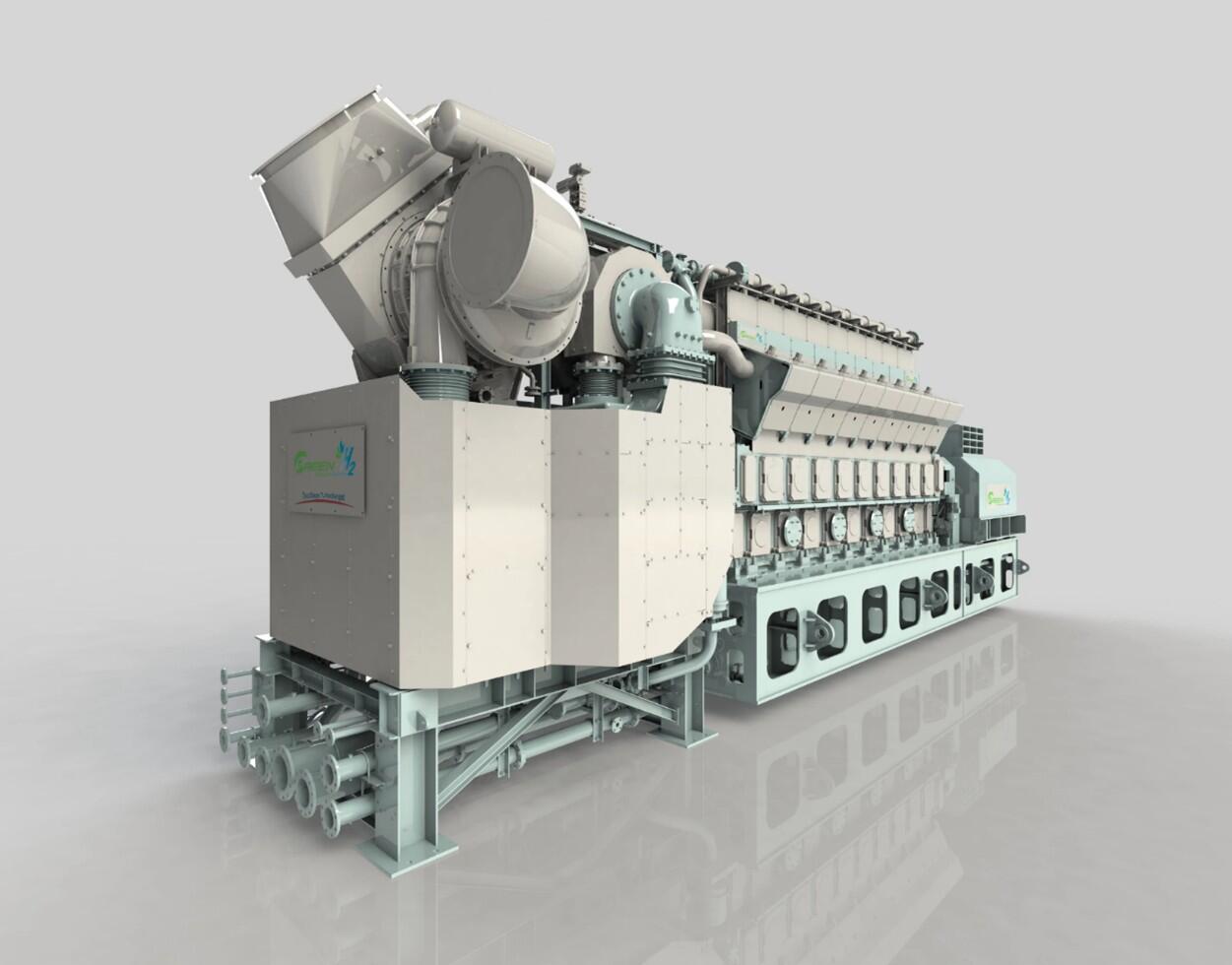
The "Kawasaki Green Gas Engine fueled up to 30% hydrogen KG-18-T.HM" is a gas engine based on the KG-18-T and that enables the use of fuel blended with 30% hydrogen by volume. Through hydrogen co-firing, the engine achieves an approximately 10% reduction in CO2 emissions* compared with our conventional natural gas-only gas engine (KG-18-T). In recognition of its high future potential in the transition category, it was selected as the recipient of the Kawasaki Ecology Prize 2025. * Based on operation at rated output for 4,000 hours per year with 30% hydrogen co-firing External awards for this product are as follows:
External Awards
- Cogeneration Foundation, "Chairman’s Award" in Technology Development Category at the Cogeneration Awards 2024
- Nikkan Kogyo Shimbun, "Nippon Brand Award" at the 68th Top 10 New Product Awards