
Sustainability Framework
- Basic Policy on Sustainability
- Sustainability Promotion System
- In-house Sustainability Education and Awareness Building
Basic Policy on Sustainability
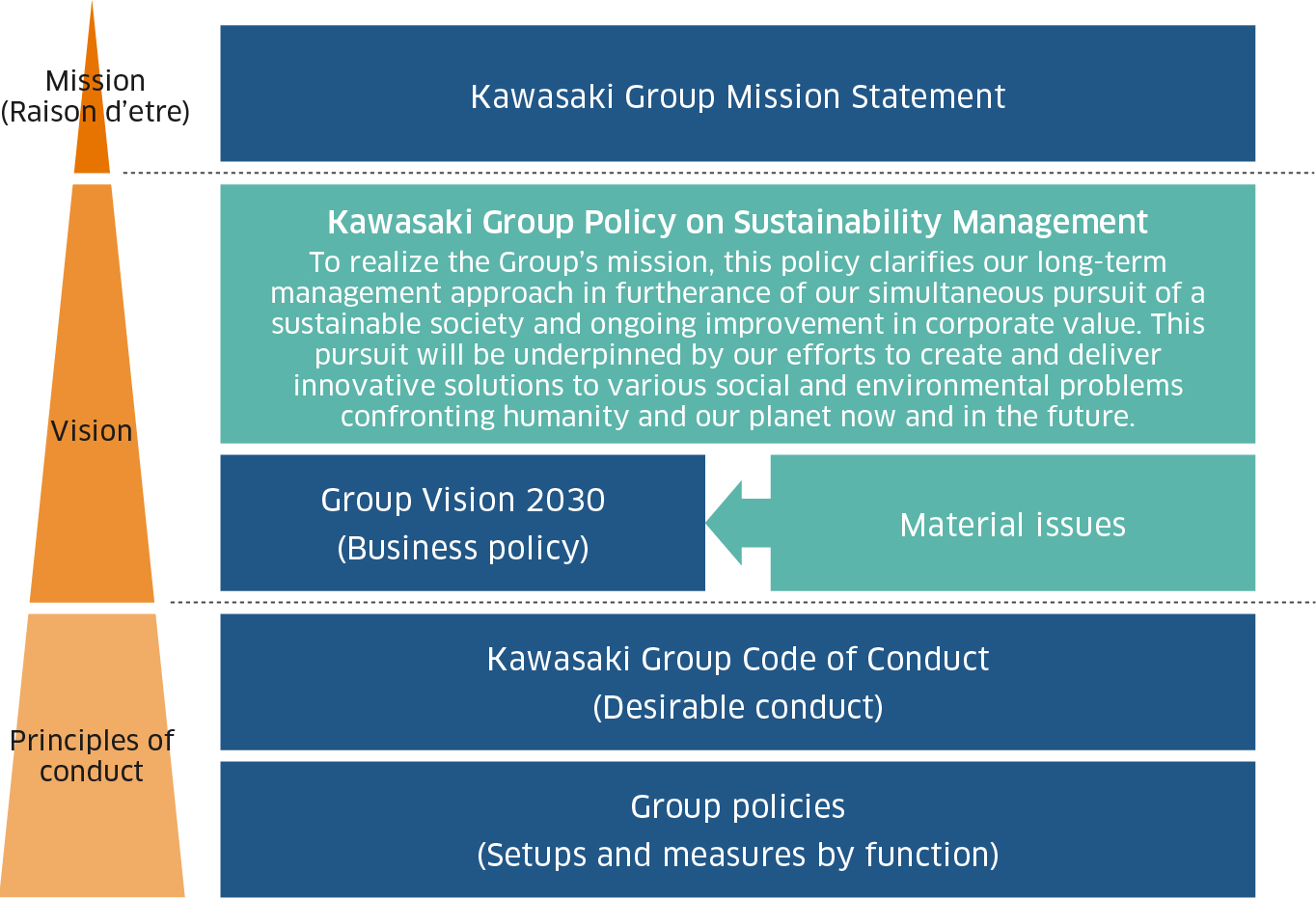
The Kawasaki Group has formulated the Kawasaki Group Policy on Sustainability Management to clarify the position of sustainability in management. To achieve our Group Mission, we consider our contribution to the sustainability of society and the environment through our products and services to be our mission as a company and will take on the challenge of creating and delivering innovative solutions to various social and environmental problems confronting humanity and our planet now and in the future. Also, by engaging in responsible corporate behavior and strengthening our business foundations, we aim to simultaneously achieve a sustainable society and continuous improvement in the corporate value of our Group.
In accordance with this policy, we periodically review material issues (materiality) in business activities and perform management while taking into consideration the business environment and requests and expectations from stakeholders. In the review conducted in fiscal 2021, we defined in the Group Vision 2030 three focal fields—“a safe and secure remotely connected society,” “near-future mobility,” and “energy and environmental solutions”—as social and environmental value created through our business and identified these fields as the most material issues to be achieved by the Group over the long term in response to pressing social issues. We also believe that there is a strong alignment between the Group Mission and the SDGs, and by implementing initiatives within each of the three focal fields identified as the most important issues, we seek to contribute to the achievement of the SDGs through our business activities.
Furthermore, as a company that provides decarbonization solutions to customers through the hydrogen and other businesses, we will seek to decarbonize business activities including value chains at an early stage, positioning priority issues including business and human rights, promotion of human resource activities, compliance, technology development, and DX as essential foundations of our business activities, and we will reinforce initiatives in these areas.
Positioning of Policy on Sustainability Management

Sustainability Promotion System
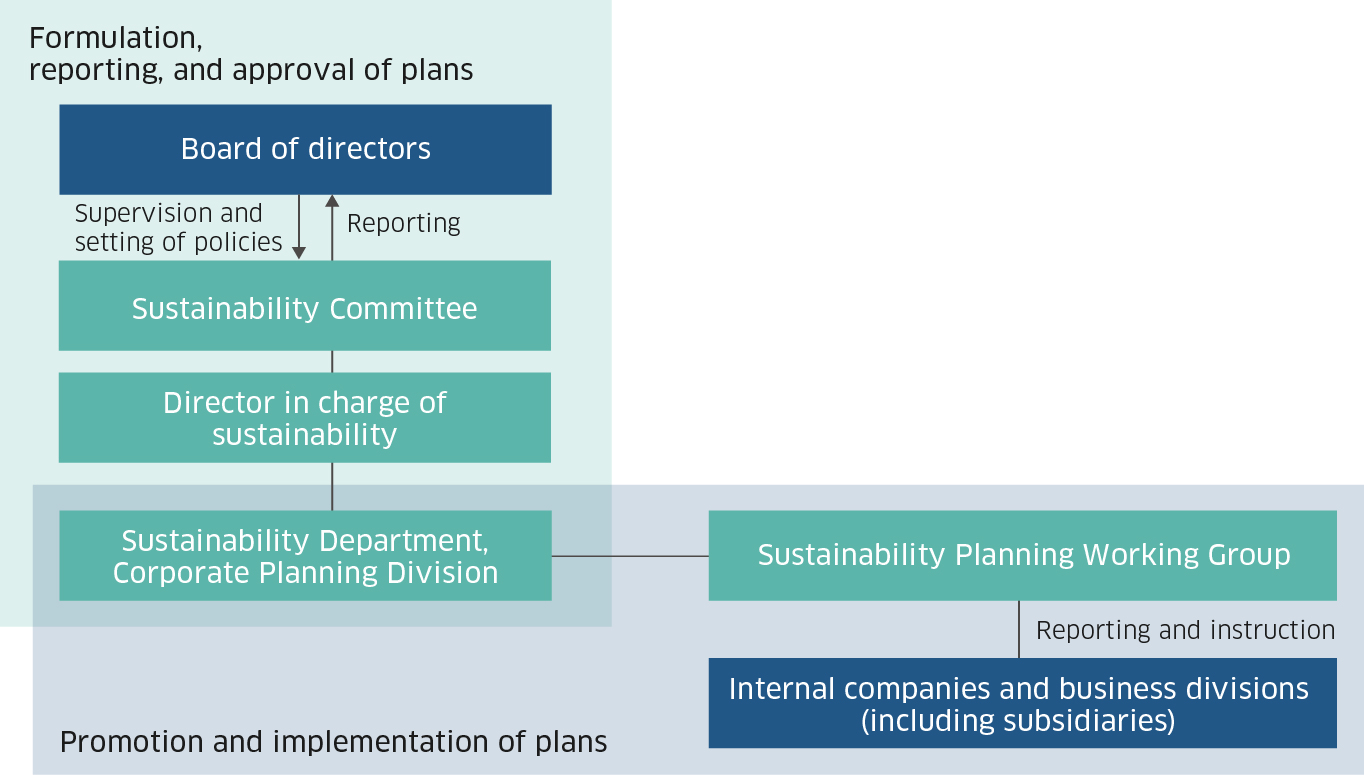
Within the Kawasaki Group, the Board of Directors is positioned as the highest decision-making body that deliberates on and decides fundamental sustainability policies and fundamental plans throughout the entire group. The Kawasaki Group adopts a system where the Sustainability Committee, as a committee of executives chaired by the President, is set up under the supervision of the Board of Directors to decide various measures based on the fundamental plans outlined by the Board of Directors and to report the progress of these measures to the Board of Directors. In addition, the Corporate Planning Division oversees sustainability to enhance the capacity to formulate plans relating to sustainability as well as to actively promote sustainability as an integral part of the management strategy. In day-to-day business activities, the Sustainability Department plans and proposes various measures relating to the environment, human rights, and other topics and works in collaboration with the Sustainability Planning Working Group, which is made up of individual divisions of the Head Office, to promote sustainability management including each internal company and subsidiary.
Sustainability Promotion System
Responsible Officers
Chair of Sustainability Committee: Yasuhiko Hashimoto, Representative Director, President and Chief Executive Officer
Director in charge of sustainability (CSO): Katsuya Yamamoto, Representative Director, Senior Corporate Executive Officer
Oversight of Sustainability by the Board of Directors
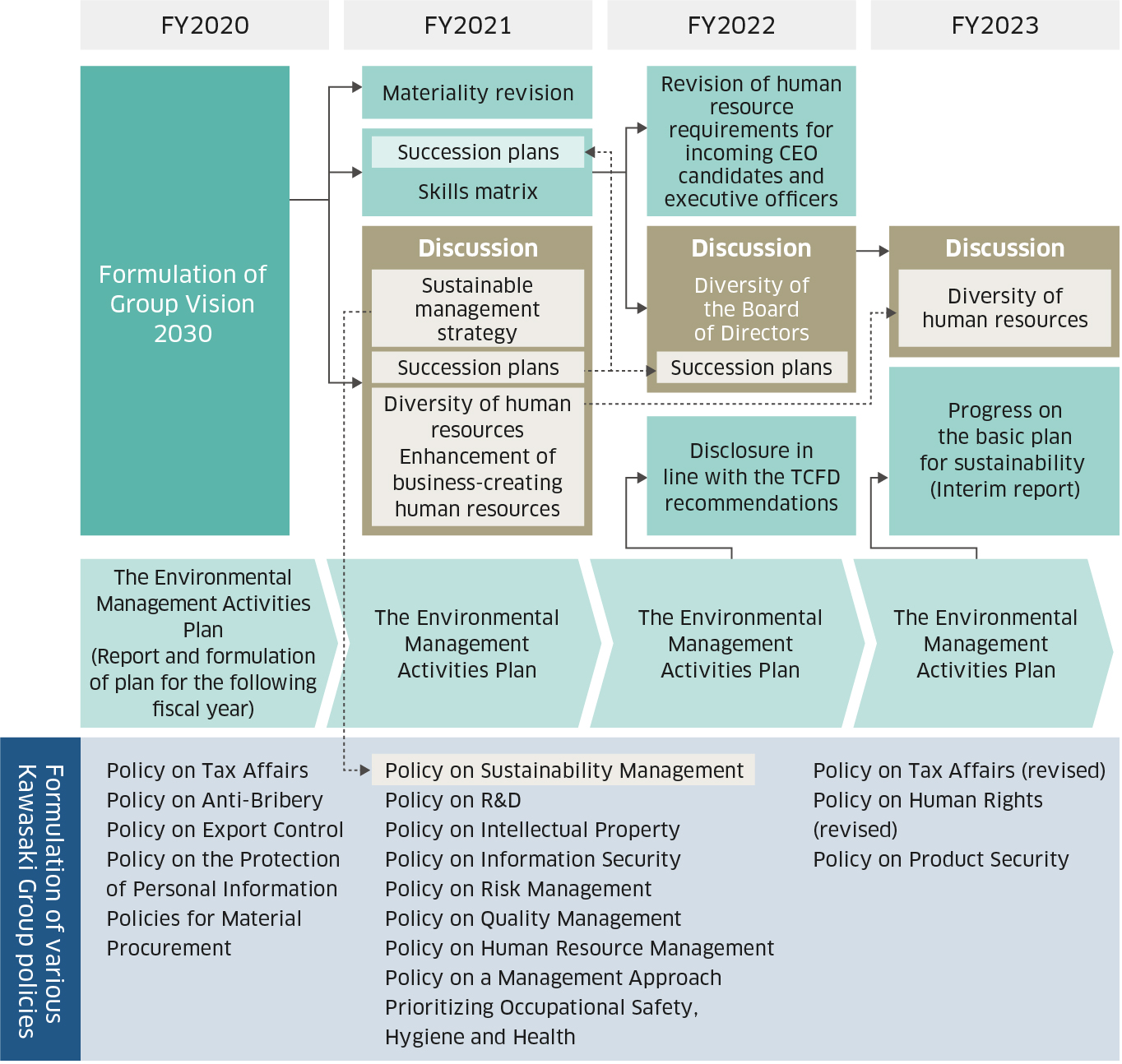
The Board of Directors has established various Group policies, which clearly stipulate our fundamental concepts and specific policies. Since the formulation of Group Vision 2030, in addition to the Environmental Management Activities Plan and so on discussed heretofore, the Board of Directors has also held highly effective discussions on important topics relating to human capital, including reform and operation of the personnel system to strengthen the management foundation, the skills matrix for directors and succession plans, the diversity of human resources, and the employee engagement, with the aim of realizing our Policy on Sustainability Management. Sustainability-related topics discussed and reported in the Board of Directors in recent years are shown in the diagram below.
Topics for Discussion at the Board of Directors
Reflecting ESG Indicators in the Executive Compensation System
In May 2024, the Board of Directors adopted a resolution to partially revise the compensation system for directors (excluding directors who are Audit & Supervisory Committee members and outside directors) and executive officers. Under the new system, employee engagement indicators and ESG indicators (CO2 reductions and third-party institution evaluations) are reflected as independent evaluation metrics for performance-based compensation. For employee engagement indicators, the payment ratio is determined according to the ratio of employees who give high scores to both “Engagement (job satisfaction)" and "Enablement (productive work environment)" in the Employee Engagement Survey, as part of short-term incentives to be paid in cash. For ESG indicators, the payment ratio is determined taking into consideration an evaluation of the degree of achievement of CO2 reduction targets through the Company’s business activities and the provision of its products and services, together with third-party evaluations (Dow Jones Best-in-Class Index*), as part of long-term incentives utilizing the mechanism of a stock benefit trust.
* Stock index related to sustainability by S&P Global Inc.
|
Sustainability Committee
For agenda items pertaining to sustainability, the Sustainability Committee deliberates and reports mainly on the following matters:
- Measures contributing to the realization of the sustainability of both society/environment and the Kawasaki Group and the enhancement of the Kawasaki Group’s corporate value, as well as their practice and state of achievement
- Measures to understand, reduce, and eliminate the negative social and environmental impact of the Kawasaki Group’s business activities, as well as their practice and state of achievement
The Sustainability Committee is chaired by the President and composed of internal company presidents, the President of Kawasaki Railcar Manufacturing, the President of Kawasaki Motors, the director in charge of sustainability, the general managers of Head Office divisions, and others. Outside Directors attend meetings so that the committee can glean the benefits of their external expertise and opinions and reflect them in its decision-making process. Also, members of the Audit & Supervisory Committee participate in the committee as part of their auditing of the execution of business. The Sustainability Committee meets at least twice a year in principle. In fiscal 2025, it met three times, and is reporting to the Board of Directors.
Risk Management Regarding Sustainability
The identification and assessment of risks pertaining to sustainability are carried out by the Sustainability Committee, which deliberates and reports on necessary actions to respond to changes in the business environment and stakeholder demands and expectations, in terms of both the risks and opportunities. In fiscal 2025, discussions focused mainly on our responses to sustainability disclosure regulations and ESG evaluations, in addition to those on actions taken on biodiversity and the promotion of human rights due diligence. Furthermore, in the regular revision of material issues (materiality), the Sustainability Committee assesses the risks of each issue. Details of these assessments are reported to the Board of Directors according to their significance, and the Board supervises the status of actions taken regarding sustainability issues.
Furthermore, in company-wide risk management undertaken by the coordinating risk management departments, risks are designated as subject to monitoring, such as sustainability-related matters; matters pertaining to the global environment, in particular those aimed at the realization of a carbon-neutral and recycling-orientated society; as well as matters relating to securing human capital for the purpose of strengthening organizations and the human resources responsible for providing new value. The responsible departments continuously conduct risk assessments and monitor these risks, and details of these efforts are reported to the Board of Directors a minimum of two times a year. In fiscal 2025, reports were submitted four times, and the Board deliberated on the direction of responses and provided necessary feedback to the departments that are subject to each risk.
|
Sustainability Targets and Indicators
The Group classifies material issues (materiality) into two broad categories: “social and environmental value created through our business” and “foundations of our business activities.” Initiatives undertaken through main business are defined as the most material issues to be achieved by the Group over the long term, while other issues that seek to achieve these critical challenges are positioned as basic items.
The areas categorized as “social and environmental value created through our business,” i.e., “a safe and secure remotely connected society,” “near-future mobility,” and “energy and environmental solutions,” are set as three focal fields in the Group Vision 2030, with targets set for achievement by 2030, and progress toward those targets is regularly disclosed in integrated reports and by other means.
Additionally, we position issues of particular importance in achieving “social and environmental value created through our business,” as “foundations of our business activities.” These include business and human rights; the promotion of human resources activities; compliance; and technological development / digital transformation (DX). We set quantitative targets and KPIs relating to these material issues, with the Board of Directors monitoring progress on major KPIs each year.
In-house Sustainability Education and Awareness Building
Utilizing a variety of tools, such as educational seminars and the in-house intranet, the Kawasaki Group carries out education and awareness-building programs related to sustainability for its officers and employees. Sustainability education and awareness building are provided through grade-specific training for such groups as new employees and newly appointed assistant managers, managerial staff, and senior management, as well as training for persons in charge of overseas businesses and mid-career hires. Furthermore, e-learning training on topics including the Sustainable Development Goals (SDGs), the environment, and business and human rights has been conducted for domestic Group employees since fiscal 2020. Starting in fiscal 2024, we conducted study sessions for relevant personnel in the Sustainability Planning Working Group and business segments in order to deepen understanding of external trends relating to sustainability and the status of in-house measures. In addition, to ensure that all Group employees are fully informed with regard to sustainability, we regularly provide information on sustainability via our Japanese-language Group newsletter Kawasaki, our Group-wide English- and Chinese-language newsletter Kawasaki On The Move, and Kawasaki Group online!, our in-house app.
|
Contact
If you need more information about our business,
please feel free to contact us.