Human Resource Management
Management Approach
Our Basic Stance
For the purpose of realizing its Group Vision 2030, the Kawasaki Group believes that it is important to evolve the nature of its people and organizations alongside the transformation of its businesses. In order for us to sustainably provide new value sought by society as we move forward, an organizational climate in which our employees individually keep on challenging themselves with high aspirations and collectively generate positive outcomes as a team is imperative. Based on this understanding, in August 2025, the Group revised its preexisting Kawasaki Group Policy on Human Resource Management, its basic policy on human capital, accompanied with a name change to the Kawasaki Group Human Resources Policy. This policy espouses the following three guidelines based on the slogan “Continue to Challenge, Continue to Achieve. Together.”
- We build a strong foundation that enables employees to set ambitious goals and take on challenges.
- We provide opportunities for every employee to unlock their potential and contribute to society through challenges and growth.
- We nurture a culture of teamwork, mutual respect, and drive where the individual and organization can grow together.
These guidelines form the backbone of all our personnel measures. We will proceed to develop our people and organizations so that employees can take on challenges with confidence in their own ability. Going forward, the Human Resources Division will spearhead our efforts to disseminate and practice this Policy companywide as we continue endeavoring to foster an organizational culture of taking on challenges and sustainably enhance our corporate value.
Guidelines on Human Resource Management
From the standpoint of human resource development, we believe it is necessary to develop human resources capable of undertaking the challenge of engaging with new business domains and delivering results that go beyond the boundaries of internal organizations and of product and service categories. To that end, in 2021, we initiated our personnel system based on the concept of “Challenge & Commitment,” which involves supporting and evaluating human resources who adopt lofty goals and carry out the necessary work with determination and speed of their own accord. In addition to securing and assigning human resources from both within and outside the Company, regardless of age, gender, nationality, or other attributes, who can fulfill expected roles and achieve results, we are conducting proper personnel assignments based on assessments of behavioral characteristics and training programs for senior and middle management as we work to develop management-level employees. From the standpoint of improving the company environment, we believe that creating an environment where a greater number of human resources can experience job satisfaction and ease of work is crucial to continue being an open, free-spirited, and creative team that surpasses boundaries and continues to grow, as stated in Group Vision 2030. Furthermore, for the sustained enhancement of our corporate value, we are endeavoring to create an organization that enables individual employees active around the world to fully display their diverse abilities regardless of nationality, gender, age, religion, disability and so on and to maximize this talent. These proactive efforts to promote diversity have been recognized, and we have been selected as a “Nadeshiko Brand” for women's participation in the workforce. We have also obtained such certifications as “Eruboshi” and “Kurumin.”

“Challenge & Commitment”
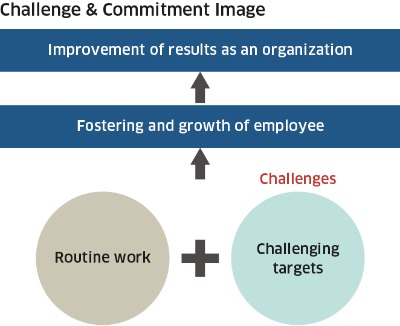
“Challenge & Commitment” is an initiative that promotes challenges in new fields so as to achieve our further growth as a Group. By not only conducting routine work but also setting more challenging targets and boldly making challenges, we will enhance our results as an organization. At the same time, our aim is to foster and grow our employees through detailed conversations with supervisors at the time of setting goals and follow-up. In addition, to further clarify reflection in performance assessment, through absolute evaluation we reflect target achievement directly in bonuses and have increased the portion paid in accordance with the degree of target achievement.
Challenge & Commitment Image
Personnel-related Structures
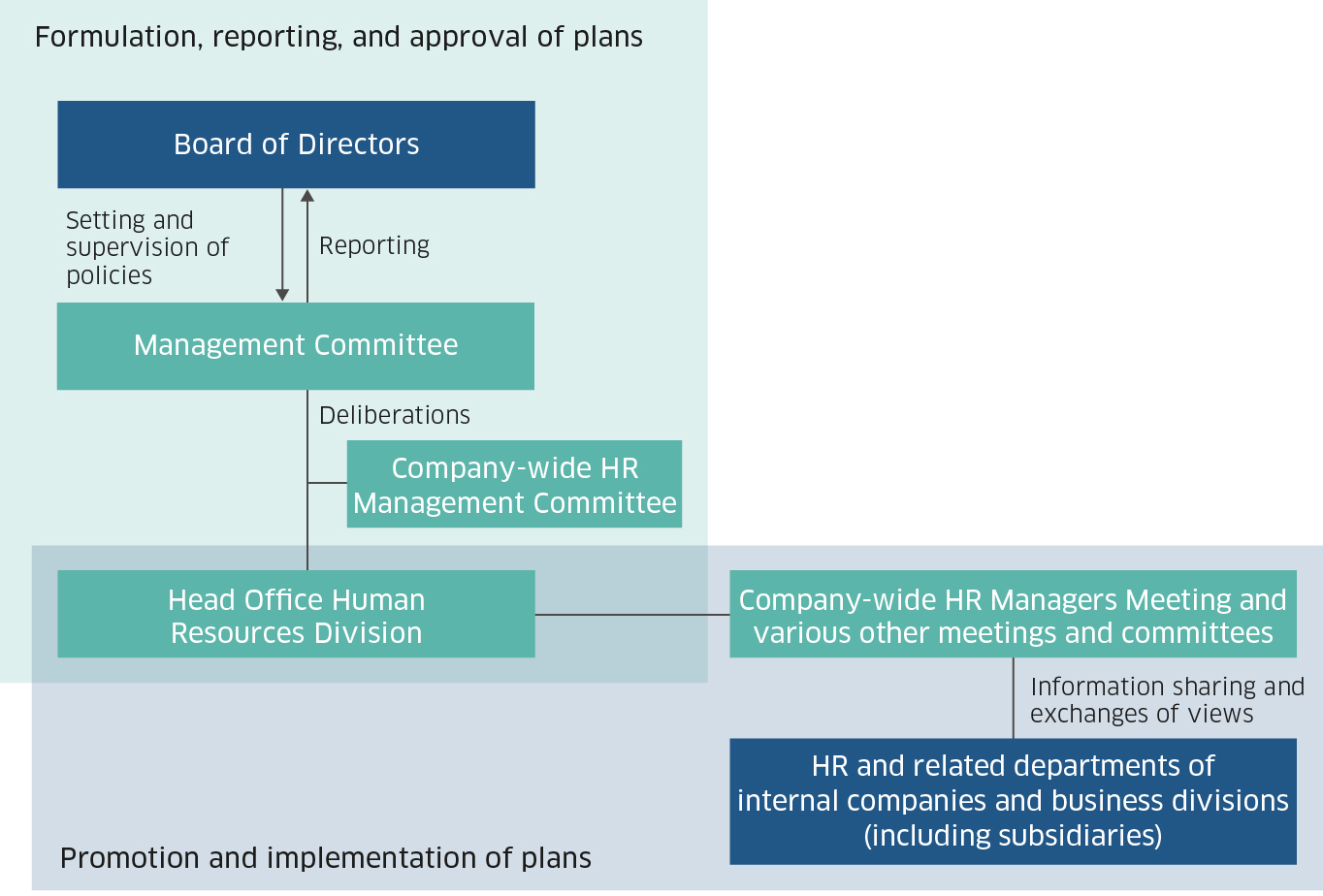
Company-wide policies on human resource development and utilization with significant potential impact on corporate management, in particular: 1) cultivating corporate managers, 2) the application of human resources in key strategies, 3) the assignment of human resources to new business and new product operations, and 4) the status of human resource measures in operation, and other matters, are discussed and reviewed by the Company-wide HR Management Committee. With the president as its presiding officer, the Company-wide HR Management Committee is comprised primarily of internal company presidents and the Presidents of Kawasaki Railcar Manufacturing Co., Ltd. and Kawasaki Motors, Ltd. and meets four times per year. This framework is designed to reflect the content of deliberations by the Company-wide HR Management Committee, with various measures then discussed at Management Committee and subsequently reported to the Board of Directors. In addition, the Head Office Human Resources Division maintains various meetings and committees in which division managers in charge of human resources and labor at the business segments convene to gather views and opinions on the drafting of detailed human resource initiatives and communicate Company-wide policies.
Human Resource Management System
Human Resource Committees and Meetings
| Body | Purpose | Attendees | Meeting frequency |
|---|---|---|---|
| Company-wide HR Management Committee | To discuss and consider Company-wide policies on human resource development and related matters with the potential to significantly impact corporate management |
|
Four times a year |
| Company-wide HR Managers Meeting |
|
|
Once a month |
| Company-wide meeting of managers of labor administration section | Administrative-level discussion, consultation, and mutual communication on matters under the jurisdiction of the Human Resources Planning Department, Human Capital Development Department, and Human Resources & Labor Administration Department |
|
Once a month |
| Meeting of managers in charge of safety & health management | Administrative-level discussion, consultation, and mutual communication on matters under the jurisdiction of the Safety & Health Management Department |
|
Four times a year |
Responsible Officers
Executive Officer Responsible for Human Resources: Takashi Torii, Managing Executive Officer
Takeshi Oyamada, Executive Officer, General Manager, Human Resources Division
Company-wide HR Management Committee: Yasuhiko Hashimoto, Representative Director, President and Chief Executive Officer
Other various HR meeting bodies: Senior Managers from the Head Office Human Resources Division
Responsible Executive Organ and/or Committee
Company-wide HR Management Committee
Employee Engagement
K-Win Activities (Kawasaki Workstyle Innovation)
K-Win activities are an initiative to change the corporate culture and individual mindsets to create an organization in which all employees can experience job satisfaction and actively contribute, thereby facilitating achievement of our Group Vision 2030. These activities aim to encourage all Kawasaki’s members to take on challenges that go beyond existing boundaries and create new value toward the solution of social issues. We are working to realize our vision of a company where every employee brings pride and enthusiasm to their work, and where their contributions directly enhance corporate value.
Vision for Our Employees and Organization
We have identified a vision for our employees and organization as described below. This vision is aimed at making effective use of human resources with an eye to total business portfolio optimization, maximizing results by improving productivity, and realizing value creation by bringing together diverse insights.
- People and organizations with high levels of engagement, job satisfaction and enjoyment, and ease of work
- Organizations in which every employee takes specific actions that go beyond internal and external boundaries based on market-in perspectives for achieving the Vision
Priority Issues to Be Addressed in K-Win Activities
Encourage the formation of connections and dialogue that link management topics with employees: proactively moving in a single direction
- Inform employees about Group Vision 2030
- Promote direct dialogue with employees, including through progress briefings on business policy and meetings in a circle
- Establish shared awareness with employees and revitalize organizations through the promotion of one-on-one engagement
Create a crossover system with a focus on demonstrating competence and results: break down existing constraints and overcome internal and external boundaries
- Shift to new workstyles and advance communications (e.g., through remote work and the use of DX)
- Share information and solve cross-organizational issues using a suggestion box on the Company intranet*
- Expand opportunities for employees to take on new challenges both inside and outside the Company through the Career Challenge Program and Career Development Leave Program
* A system for accepting feedback on issues and improvement proposals from employees regarding work processes and organizational management and working with related divisions to facilitate improvements
Visualize current statuses of organizational units and individuals and address challenges using the WinDEX engagement survey: improve engagement
- Regularly conduct engagement surveys and visualize Company-wide issues identified based on the results
- Analyze issues and promote improvements at the organizational unit level through collaboration between management and frontline staff
- Implement specific improvement actions based on dialogue led by supervisors
K-Win Activities Structure
The structure consists of two main parts: the K-Win Activities Implementation Secretariat, led by the Head Office, which promotes Company-wide activities, and the Business Segment Implementation Secretariat, which promotes activities within each organization. Additionally, employees with strong determination to promote activities and expertise in various themes actively participate in actions to drive the initiatives forward.
[Examples of specific activities in each business segment] As part of K-Win activities, each business segment is implementing its own unique actions tailored to its specific issues based on Company-wide policies. The following are examples of such initiatives. Each business segment carries out a variety of actions, with the Company then promoting the horizontal dissemination of best practices and reciprocal learning by sharing these initiatives with the Management Committee.
| Themes | Main initiatives |
|---|---|
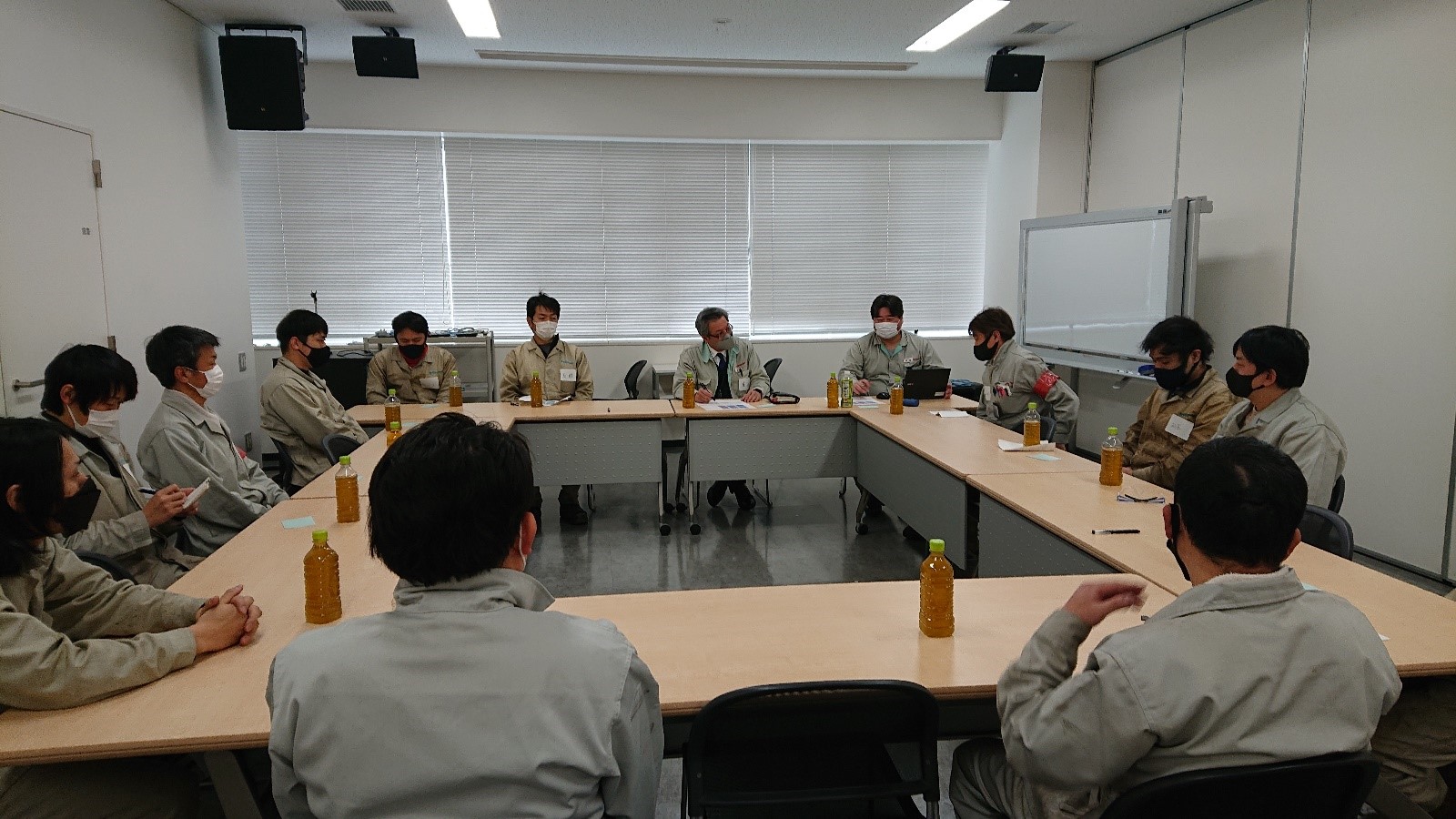
| Promote dialogue between management and employees | Opportunities for direct dialogue between management and employees are provided by many of the business segments. These initiatives are implemented in a variety of formats tailored to the characteristics of each business segment. They include dialogues in a townhall meeting format, circle meetings between executives and production specialists, and roundtable discussions attended by the President himself. Efforts to enhance both the quality and frequency of these dialogues are also expanding. These include intensive dialogue sessions focused on key organizational units based on WinDEX results and the regular distribution of videos outlining business policies. |
| Revitalize the organizational and corporate culture and foster a sense of unity | We are working to ensure psychological safety and improve the quality of dialogue through the implementation of management training and coaching skills training. We are also rolling out voluntary activities to promote communication as well as conducting exchange events at respective sites organized by employee volunteers. In addition, we are fostering a sense of unity that transcends division boundaries and establishing mechanisms for reciprocal learning through initiatives such as holding joint kickoff meetings across divisions and introducing an awards program that recognizes cross-organizational collaborative achievements. |
| Support the active contributions and career development of diverse human resources | We are working to create an environment at respective sites where diverse human resources can actively contribute, through initiatives such as career development support for women, a trial program for employees to bring children to work, and projects aimed at enabling people with disabilities to work by leveraging technology. In addition, we are expanding initiatives to support autonomous career development, such as hosting networking events at which employees introduce their respective work duties to colleagues, and implementing a talent management system. |
K-Win Implementation Structure
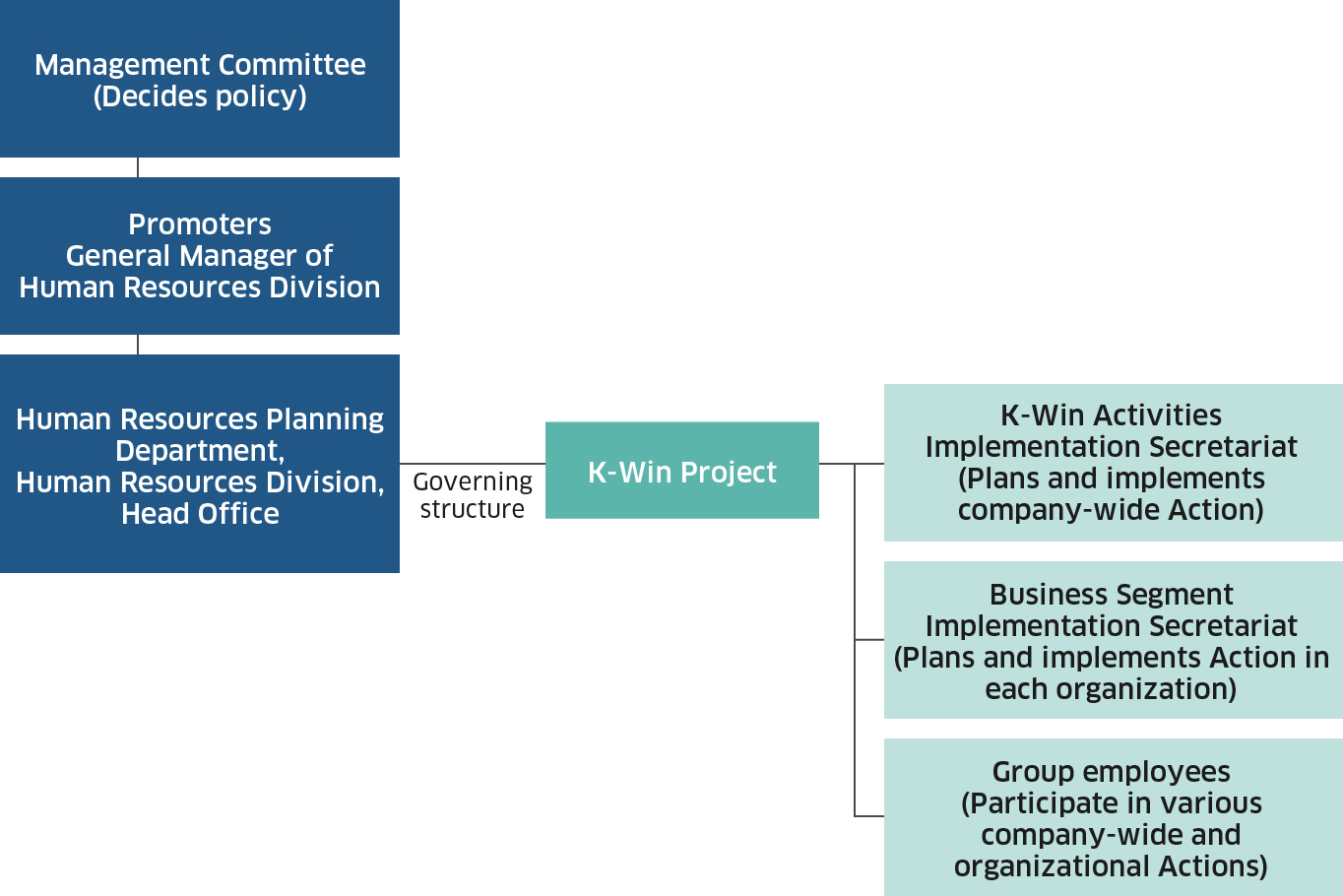
Responsible Officer
Takeshi Oyamada, Executive Officer, General Manager, Human Resources Division
Responsible Executive Organ and/or Committee
K-Win Activities Implementation Secretariat
Overview of the WinDEX Engagement Survey
As part of our promotion of K-Win activities, we regularly conduct WinDEX (K-Win x Index) engagement surveys to connect the activities to the visualization and continuous improvement of organizational challenges. This survey uses a framework that is widely deployed by global companies and is comprised of the two result indicators with a high correlation with business performance of “engagement (job satisfaction)*1” and “enablement (productive work environment)*2.” To realize the Group Vision 2030, we have set the global level as our target and established the goal of raising the consolidated ratio of employees whose two result indicators both exceed the global average (most effective employee ratio) to over 50% by fiscal 2030 (the result in fiscal 2025 was 36%). Survey results are analyzed on a Company-wide basis and shared at the Management Committee. They are then rolled out to internal companies and business divisions, with dialogues led by supervisors and the formulation and execution of action plans promoted in parallel. This process is used to facilitate the operation of a Company-wide improvement cycle based on the two axes of Company-wide actions led by management and workplace actions led by supervisors. Specifically, by linking the “most effective employee ratio” to corporate officer compensation and the target management system (Challenge & Commitment), we position improvements in engagement as “management targets” rather than “human resource measures,” thus encouraging proactive involvement from management and supervisors in each business segment.
*1 Ratio of employees who responded positively to multiple questions in the employee engagement survey regarding whether employees are willing to go an extra mile and are proud to work for the company
*2 Ratio of employees who responded positively to multiple questions in the same survey regarding whether employees have opportunities to do interesting work and the environments allow them to be productive
Most effective employees
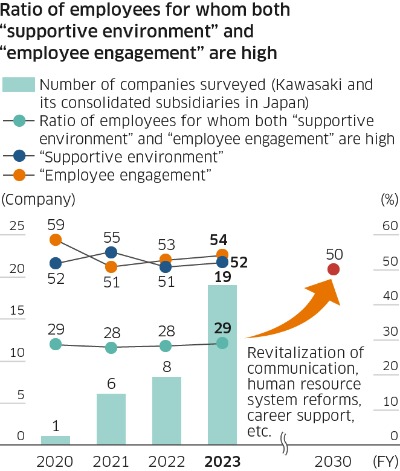
Workstyle Reform
For our K-Win activities, we are promoting workstyle reform as one initiative to enhance job satisfaction and create a more productive work environment. In terms of policies, we introduced a remote working program (teleworking program) available to all employees in fiscal 2018 and are undertaking initiatives to create a working environment that allows employees to work flexibly in ways aligned with their own lifestyles. Additionally, since fiscal 2025, we have introduced the “Best Change Award,” an internal awards program for workstyle transformation, on a trial basis, with this initiative intended to encourage employees to proactively re-evaluate their own workstyles. We are promoting proactive behavioral changes and reciprocal learning among all employees by visualizing and horizontally disseminating best practices in areas such as business automation and process improvements. Furthermore, we will seek to minimize the need to increase headcount even during periods of business growth by leveraging robots and AI and visualizing and enhancing the efficiency of business processes through digital transformation (DX). At the same time, we will realize workstyles that allow employees to experience a genuine sense of “satisfaction” and “growth” by enabling them to focus on high-value-added work.
Securing and Retaining Human Resources
Hiring
Kawasaki secures personnel in accordance with the required skills and purpose at hand. We are committed to securing personnel for new businesses and for business expansion (especially in DX, hydrogen-related businesses, and legal) by means of mid-career hiring, emphasizing skills and experience; and to securing key personnel for organizational units to continuously deepen businesses by means of new graduate hiring, emphasizing potential. As a result of these efforts, the proportion of mid-career hires has been increasing each year, and the ratio of mid-career hires to all new hires at Kawasaki Heavy Industries, Ltd. in fiscal 2025 came to 62.0%. For the hiring of new graduates, we emphasize “objectivity in selection” and “diversity of hires.” Toward the realization of our Group Vision 2030, we are endeavoring to use selection methods which differ from traditional models, aiming in particular to secure “transformational talent” who possesses a problem-solving mindset in the face of prevailing circumstances and who will act with a sense of resolute conviction. To give an example, we evaluate the ability of new graduates to tackle challenges in duties actually experienced by employees using a group work format, and to maintain strong conviction in meeting those challenges through negotiations with fellow students and employees in addition to examining solutions to the challenges. In addition, we collaborate with educational institutions to hold technical workshops for high school, university, and technical college students as well as to implement career training efforts in cooperation with employees in order to increase the number of future applicants amid the declining birth rate, aging population, and burgeoning trend away from science subjects. Plus, in January 2025, we commenced operation of an alumni network for resignees and individuals who withdrew from the selection process. In doing so, we are moving forward with the establishment of a structure that enables us to stably secure capable human resources without being swayed by the external environment.
| For information on the employment of diverse human resources, please refer to Diversity, Equity, and Inclusion. |
Employee Evaluations
Our Approach to Human Resource Evaluation
Kawasaki operates a personnel system that rewards employees based not on such individual characteristics as age, but on the size of the employee’s role, the ambition of the targets they set, their ability to carry out the necessary work with determination and speed, and the results they achieve. By using this system, we aim to promote the further growth of our human resources and ongoing corporate growth. At the core of this is our target management system, which values commitment and ambitious effort.
Employees set targets for themselves that comprise both the expected targets entailed in carrying out their basic responsibilities as well as targets that reflect taking on self-directed challenges and rising above their normal roles to generate additional added value. Supervisors and their subordinates meet regularly (at least once per quarter) to discuss hurdles to achieve these targets and employees’ initiatives to do so. At the end of the fiscal year, employees themselves and their supervisors evaluate their performance regarding each target, and supervisors provide feedback that includes the reasons for their evaluations and reach a final evaluation. They then discuss initiatives for the coming year and the subordinate’s career path. Moreover, with this system, the results of performance evaluations are reflected in bonuses.
To ensure fair and equitable evaluations, we have established fixed evaluation procedures. We also incorporate case studies and other training aimed at improving evaluation skills into the training of managers. In addition, for managerial staff, we implement 360-Degree Surveys aimed at observing a person’s behavioral characteristics in an objective and multisided manner, clarifying their personal traits as seen by others, and using the results as reference for the person’s training, future assignments, and so on. Moreover, once a year, the labor union is briefed on promotions and compensation to verify that employees are being treated in an equitable and fair manner.
“The right personnel in the right places” and “pay for mission”
Instead of seeing the existing organization and human resources as the point of departure, based on the concept of the “right personnel in the right places,” first of all we will establish the organizations and posts necessary for achieving our vision (“right places”). Then we will clarify the conditions required of people doing this work, decide the suitable human resources, and make assignments accordingly (“right personnel”). In considering assignments, we are introducing a mechanism with a high degree of accuracy in matching posts and human resources throughout the Group, conducting assessments of management ability based on 360-Degree Surveys and competency and taking account of expert knowledge and other factors. On top of that, we introduced a “pay for mission” scheme that determines wages by stipulating job ranking in accordance with the results required in the work and taking account of the contents of individual challenges. Through these initiatives, we will realize the establishment of “right places” and assignment of the “right personnel” and promote personnel strategy in tune with management policy.
Percentage of Employees Assessed by Different Evaluation Methods (Kawasaki Heavy Industries, Kawasaki Railcar Manufacturing, and Kawasaki Motors)
(FY)
| Unit | 2021 | 2022 | 2023 | 2024 | 2025 | |
|---|---|---|---|---|---|---|
| Evaluation based on target management*1 | % | 100 | 100 | 100 | 100 | 100 |
| Multifaceted performance evaluations*2 | % | 21 | 22 | 23 | 22 | 25 |
| Evaluations for ranking employees within their category | % | 100 | 100 | 100 | 100 | 100 |
*1 Evaluations based on targets and other criteria agreed to by the Line Manager.
*2 360-Degree Surveys, etc.
Support for Career Development
In accordance with our basic policy of "supporting career development that respects the individual wishes of employees," our Group strives to provide substantial opportunities for employees to clarify their goals in terms of skill development, and acquire the required knowledge, skills, and abilities, and gain necessary workplace experience.
For instance, to enable our employees to actively shape their careers, we provide them with information about our career development support measures through the “Career Support Guidebook” and offer theme-based career seminars and career counseling opportunities. We also conduct career support seminars for supervisors, promoting an environment where supervisors can support the growth and career development of their subordinates in the workplace. We also have a Career Challenge Program that enables employees who want to transfer to apply for positions in departments that are recruiting and are announced once each year. We introduced a Career Development Leave Program that allow employees who want to re-learn skills while making use of outside educational institutions including overseas universities, encouraging and supporting independent career development by employees.
In fiscal 2025, we introduced an internal human resource matching system and plan to use this in the future as a platform that incorporates secondments through collaboration with external organizations (including other companies in the same industry, startups, and local authorities).
Number of open positions (Kawasaki Heavy Industries, Kawasaki Railcar Manufacturing, and Kawasaki Motors)
(FY)
| Unit | 2021 | 2022 | 2023 | 2024 | 2025 | |
|---|---|---|---|---|---|---|
| Job postings | Number | 161 | 358 | 405 | 322 | 312 |
| Applicants | Persons | 26 | 37 | 76 | 56 | 65 |
| Successful applicants | Persons | 13 | 18 | 43 | 24 | 30 |
| Internal hire rate | % | 8.2 | 5.0 | 10.6 | 7.4 | 9.6 |
Overview of Long-term Incentives for Employees
As of fiscal 2024, we have introduced an incentive plan (RS trust) for certain managerial-level employees whose roles significantly impact the business management of the entire company. This plan grants Company shares through a trust according to points granted to employees who meet certain requirements. We introduced it as an initiative aimed at enhancing corporate value from a shareholder's perspective based on the standpoint of linking together the Company's stock price and compensation to have employees obtain an awareness of being company owners and foster their sense of business execution with the same point of view as investors. There are two types of points granted in accordance with our Stock Grant Regulations: “fixed points” according to the job grade and tenure during the evaluation period and “performance-based points” using the results of an evaluation of overall ESG-related initiatives by a third party (Dow Jones Best-in-Class Indices*) and the unit price of Company shares as indices. The transfer of shares granted is restricted until resignation/retirement based on a transfer restriction agreement executed between employees and the Company. This is intended to give them incentive to engage in the continuous enhancement of our corporate value.
* Stock index for sustainability issued by S&P Global Inc.
Retirement Payment System
Kawasaki provides a retirement payment system where employees can receive payment in a lump sum or as a pension. In addition to defined benefit pensions, Kawasaki offers defined contribution corporate pensions, which allow employees to choose their contribution amounts to suit their life plans and put them to good use in their long-term asset building plans. In principle, retirement payments are calculated in accordance with the number of consecutive years served, age, job qualifications, and performance evaluations and disbursed to all employees with a service record of at least three years with Kawasaki.
Employee Stock Ownership Association
The Kawasaki Group operates an employee stock ownership association system established to promote employee welfare (in terms of wealth building) as well as employees’ sense of involvement in management. As part of the employee benefit system, the Company matches a certain portion of employee contributions, and the dividends on shares held by employees are used to buy more shares, achieving a compounding effect and enabling employees to build wealth. Furthermore, holding shares of the Company through the ownership association helps employees gain a greater awareness of corporate management, just as for general shareholders. We believe that this will contribute to the enhancement of enterprise value over the long term.
Shares Held by the Employee Stock Ownership Association and Position on the Register of Shareholders
(FY)
| Unit | 2021 | 2022 | 2023 | 2024 | 2025 | |
|---|---|---|---|---|---|---|
| Shares held by the Employee Stock Ownership Association | Shares | 4,934,251 | 5,223,751 | 5,280,251 | 4,770,951 | 4,488,051 |
| Position on the register of shareholders (by size of shareholding) | 4th | 4th | 4th | 4th | 4th |
Contact
If you need more information about our business,
please feel free to contact us.