Working with Suppliers
Management Approach
Our Basic Stance
In the Kawasaki Group’s business activities, it is essential that our procurement activities are conducted in line with our stance toward the concept of sustainability, which includes consideration for compliance, human rights, labor, occupational safety and health, and the global environment. To this end, we must work together with not only the entire Group but also our suppliers, which are important partners in our business activities, to actively promote sustainability initiatives throughout the entire supply chain. We will respond to the demands of our customers and society by identifying risks related to sustainability throughout the supply chain, and by promoting sustainability activities together with our suppliers.
The Kawasaki Group Policies for Material Procurement and Sustainable Procurement Guidelines
The Kawasaki Group set forth the Kawasaki Group Policies for Material Procurement, which contains the Group's sustainable-procurement philosophy, and its expectations for its suppliers in that regard, as well as the Kawasaki Group Sustainable Procurement Guidelines, which further fleshes out the content of the aforementioned policy by stipulating by-laws on its expectations for its suppliers. These guidelines refer to the RBA* Code of Conduct, cover areas including compliance, human rights, labor, occupational safety and health, and considerations for the global environment, and incorporate the Kawasaki Group Code of Conduct to clarify the Group’s policy to enhance the sustainability of its entire supply chain.
* Responsible Business Alliance (RBA): International initiative promoting corporate social responsibilities across the global supply chain.
Scope of Policy Application
The Kawasaki Group and our suppliers

Structure
Procurement activities in our daily operations are carried out under the responsibility and authority of each business segment. As a cross-company body, we hold the Procurement Department Head Meeting, attended also by the director in charge of procurement, twice a year. At this meeting, in addition to deciding on common Group-wide procurement measures and policies, including those related to sustainable procurement, participants monitor the procurement-related KPIs set by each business segment and share their annual plans.
Director in charge of procurement: Hiroshi Nakatani, Representative Director, Senior Corporate Executive Officer
Sustainable Procurement Initiatives
The Kawasaki Group Policies for Material Procurement and Sustainable Procurement Guidelines can be viewed on our website. These policies and guidelines have been disseminated among related divisions, including Group companies. We furthermore assess the compliance of our suppliers with both policies through the sustainable procurement survey, and continuously confirm the status of sustainability initiatives in the supply chain, thereby endeavoring to avoid conflicts with the demands of our customers and society regarding sustainability.
The basic agreement that Kawasaki forms with suppliers includes provisions specifying that both parties should recognize the importance of corporate social responsibility and will voluntarily and proactively engage in business and social contribution activities which contribute to the sustainable development of the environment and society. In this basic agreement, Kawasaki demands that its suppliers comply with the Kawasaki Group Sustainable Procurement Guidelines. Kawasaki also directly distributes a copy of the guidelines to its suppliers. Additionally, since fiscal 2023, the Robot Business Division has been obtaining letters of agreement from our suppliers regarding the RBA Code of Conduct as part of efforts to promote sustainability in the supply chain, including responding to conflict minerals surveys.
Furthermore, domestic and overseas subsidiaries engaged in material procurement disclose their Sustainable procurement policies and guidelines on their websites as suited to their specific businesses. Through such efforts, we pursue sustainable procurement on a global and our Group-wide basis. Going forward, the Kawasaki Group will continue to promote sustainability initiatives throughout the supply chain in cooperation with suppliers.
Supply Chain Conditions
The Kawasaki Group does business on a global scale with a diverse range of suppliers at around 5,400 companies. We analyze the procurement costs for each item procured at each business segment. Together with these suppliers, we are promoting sustainability initiatives throughout our entire supply chain.
Percentage of Orders by Items Procured (Kawasaki Heavy Industries, Kawasaki Railcar Manufacturing, and Kawasaki Motors)
(FY)
| Unit | 2021 | 2022 | 2023 | 2024 | 2025 | |
|---|---|---|---|---|---|---|
| Raw materials | % | 13.9 | 15.0 | 15.2 | 14.0 | 15.3 |
| Component parts | % | 21.2 | 20.7 | 26.8 | 23.7 | 21.9 |
| Machinery and tools | % | 20.6 | 19.8 | 20.7 | 24.6 | 22.1 |
| Subcontracted processing | % | 43.6 | 44.1 | 37.0 | 37.6 | 40.6 |
| Other | % | 0.6 | 0.4 | 0.3 | 0.2 | 0.2 |
| Total | % | 100 | 100 | 100 | 100 | 100 |
Stipulating Significant Suppliers
Respective business segments select significant suppliers taking into consideration the following assessment criteria, such as specific risks and ESG aspects related to individual products.
- Scale of procurement
Transaction amounts above a given threshold - Sector- and product-specific risks
The importance of the parts and equipment in key products and the existence or otherwise of alternative suppliers - Status/level of sustainability initiatives
The results of a survey on the status of sustainability initiatives in line with the Kawasaki Group Sustainable Procurement Guidelines, which stipulate requirements related to ESG and other issues
Number and Ratio of Significant Suppliers (Kawasaki Heavy Industries, Kawasaki Railcar Manufacturing, and Kawasaki Motors)
| Types of suppliers | Numbers of suppliers | Share of total procurement expenditures |
|---|---|---|
| Total of Tier 1 suppliers | 5, 505 companies | 100% |
| Significant suppliers, included in Tier 1 suppliers | 572 companies | 80% |
* As of March 2026
Supply-Chain Risk Assessment
Since fiscal 2016 Kawasaki has conducted surveys of domestic and overseas suppliers to assess their compliance with the Kawasaki Group Sustainable Procurement Guidelines and evaluate our supply-chain risks.
This survey is comprised of a total of 83 questions, comprehensively covering each item of the RBA Code of Conduct in a format designed to inquire into suppliers’ initiatives in each of nine major categories. These categories include corporate governance regarding sustainability, compliance, consideration for human rights, labor, and occupational safety and health, consideration for the global environment, and harmonious co-existence with society.
In fiscal 2025, continuing from the previous fiscal year, we again identified compliance and human rights as priority management categories and performed assessments on the promotion status regarding these categories based on the results of the survey. We then formulated corrective action plans mutually agreed between the two companies for some suppliers that had failed to achieve Kawasaki’s required levels, subsequently supporting the implementation of these plans and conducting on-site assessments aimed at confirming the status of sustainability-related initiatives where needed.
Going forward, we will continue to optimize the content of survey questions to reflect societal demands and provide support for corrective action plans to further enhance sustainability initiatives throughout the entire supply chain.
Evaluation Results from Sustainable Procurement Survey
In fiscal 2025, continuing from the previous fiscal year, we again implemented a survey of major suppliers in Japan and received replies from 95 significant suppliers. All 14 companies that formulated corrective action plans in fiscal 2023 and fiscal 2024 have completed implementation of their plans and one of the four companies that formulated plans in fiscal 2025 has completed implementation of its plan as of the end of July 2026.
| Unit | FY2023 | FY2024 | FY2025 | |
|---|---|---|---|---|
| Suppliers that responded to the survey | Number of companies | 533 | 200 | 95 |
| Significant suppliers included in the survey | Number of companies | 531 | 200 | 95 |
| Suppliers we have conducted on-site assessments | Number of companies | 1 | 2 | 1 |
| Suppliers that have formulated corrective action plan | Number of companies | 6 | 8 | 4 |
| Suppliers we are supporting in the implementation of corrective action plan | Number of companies | 6 | 8 | 4 |
Capacity Building for Suppliers
The Kawasaki Group procures materials across a wide range of fields organized into four groupings: Land & Air Transportation Systems, Motion Control, Motor Vehicles, and Energy & Marine Engineering. Depending on the needs of each business, for our suppliers we offer training sessions and awards programs aimed at improving performance with respect to quality, delivery, and sustainability. In addition, we directly explain Kawasaki’s approaches to sustainability through briefing sessions and documentation while informing suppliers of the important issues in supply chain management, such as human rights and the environment and requesting that suppliers enhance their sustainability initiatives.
Initiatives toward Realization of a Carbon-neutral Society
The Kawasaki Group is actively undertaking initiatives to reduce CO2 emissions with the objective of achieving net zero throughout the entire value chain by 2050, in line with our “CO2 Free” policy as laid out in the Kawasaki Global Environmental Vision 2050. We hold seminars for our suppliers to report on the status of Kawasaki Group initiatives related to carbon neutrality and facilitate understanding of this policy. Additionally, as stipulated in the Kawasaki Group Sustainable Procurement Guidelines, we request that our suppliers reduce emissions of greenhouse gas such as CO2, methane, and chlorofluorocarbons in their own business activities; pursue energy efficiency improvements; and undertake initiatives for the preservation of the global environment.
| FY | Initiative examples |
|---|---|
| FY2022 | In February 2023, at a briefing organized by a financial institution, Kawasaki reported on the status of its initiatives aimed at the realization of a carbon-neutral, low-carbon society to 93 participants, including representatives from 22 of Kawasaki’s suppliers. |
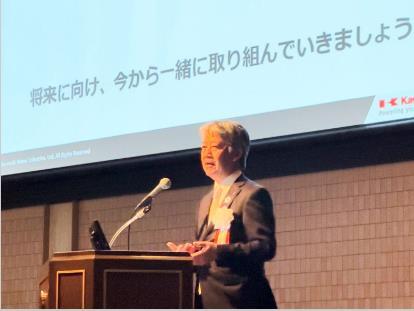
| FY2024 | In April 2024, we held a briefing on carbon neutrality for our main suppliers, with 102 suppliers (175 persons total) attending. The President appeared in person to give overviews of the Kawasaki Group’s initiatives and guidelines toward the realization of a carbon-neutral society. Meanwhile we requested that our suppliers undertake initiatives to reduce their CO2 emissions. |
| FY2025 | In January 2026, we held a carbon neutral seminar at our co-creation hub for social innovation, “CO-CREATION PARK – KAWARUBA,” which was attended by 217 of our suppliers (280 participants in total) both at the venue and online. At this seminar, we invited Sumitomo Heavy Industries, Ltd. to give a presentation, during which they introduced their CSR procurement activities, including their initiatives to reduce CO2 emissions, with the aim of promoting carbon neutrality across industry and company boundaries. |
Support for CO2 Emissions Calculations
To increase the ratio of primary data on CO2 emissions in Category 1 of Scope 3, we are gaining a better understanding of how our major suppliers manage their CO2 emissions and, since fiscal 2022, have been providing support for initiatives to calculate CO2 emissions and reduce emissions for our main suppliers. As a result, we verified the CO2 emissions of 372 suppliers for fiscal 2023 and approximately 450 suppliers (including secondary suppliers) for fiscal 2024, while providing support for measurements as needed. The results of these surveys will be reflected in the initiatives we will undertake with our suppliers in fiscal 2026 to reduce emissions.
| FY | Details of specific support |
|---|---|
| FY2022 | In July 2022, we carried out a survey of our main suppliers on CO2 emissions, getting answers on the management of CO2 emissions at 89 of them. |
| FY2023 | In June 2023, our Robot Business Division held a briefing on initiatives aimed at achieving carbon neutrality for 108 of our suppliers. The presenters provided an explanation of methods for managing CO2 emissions and initiatives aimed at reducing them. |
| FY2024 | We held three carbon neutral seminars, in July and December 2024, and in February 2025, at which we gave briefings on initiatives the Group will be pursuing with our suppliers; held seminars on support for decarbonization management provided by government and financial institutions; and provided an explanation of the calculation of Scope 1, 2, and 3 CO2 emissions for our suppliers. A total of 440 suppliers participated in these seminars. |
| FY2025 | From October through December 2025, we held three carbon neutral seminars. Continuing from the previous fiscal year, we provided an overview of emissions visualization and briefed a total of 1,249 suppliers on initiatives aimed at reducing emissions, including the utilization of energy-saving assessments and introduction of CO2-free electricity. |
Education and Training on Sustainable Procurement
Kawasaki also provides training on sustainable procurement for its employees to increase the awareness of those in charge. Specifically, Kawasaki conducts training every year for the Group’s procurement divisions to improve their understanding of sustainability efforts in the supply chain, such as the status of the company's sustainable procurement initiatives and the role that procurement staff should play. In fiscal 2025, we conducted education for 70 procurement staff members across the Kawasaki Group on the importance and necessity of sustainable procurement, including the procurement of sustainable raw materials.
Thorough Compliance in Material Procurement
Each year, the Group holds workshops for procurement divisions to ensure compliance with procurement-related laws and regulations, particularly the Act on Preventing Delay in Payment to Small and Medium-Sized Entrusted Business Operators in Relation to Manufacturing Consignment and the Construction Industry Law. Kawasaki continues to promote awareness and knowledge specifically of the said Act (the former Subcontract Act) beyond just its procurement divisions, as outlined below. We are also undertaking prompt action to respond to the legal amendments of fiscal 2025.
- In October 2009, we published a collection of examples of Subcontract Act violations, citing actual cases in which other companies had contravened this law.
- In April 2013, we posted a checklist for compliance self-auditing pursuant to the Subcontract Act on our company intranet. All employees were broadly educated about the checklist which functions as a tool for checking and correcting administrative activities prone to violations of the Subcontract Act.
- Since fiscal 2011 we have held group training sessions every year, mainly for design and manufacturing divisions at our plants and major affiliated companies. A total of about 7,000 employees have received this training so far. In addition, in fiscal 2024 we implemented e-learning training to make as many employees as possible aware of the Subcontract Act; about 21,000 employees have taken this e-learning course so far.
- In preparation for the legal amendments of fiscal 2025, we conducted internal awareness campaigns using materials from the “Briefing on Key Points of the Amendments to the Act on Preventing Delay in Payment to Small and Medium-Sized Entrusted Business Operators in Relation to Manufacturing Consignment and the Act on the Promotion of Subcontracting Small and Medium-sized Enterprises,” hosted by the Japan Fair Trade Commission and the Small and Medium Enterprise Agency, and also held briefings on the legal amendments at each plant.
Initiatives on Conflict Minerals
The Kawasaki Group respects the Organisation for Economic Co-operation and Development (OECD) “Due Diligence Guidance for Responsible Supply Chains of Minerals from Conflict-Affected and High-Risk Areas,” and is promoting activities such as collating the results of surveys conducted by the respective business segments in response to customer requests, as well as undertaking measures based on risk assessment findings. In December 2013, the Kawasaki Group posted its Policy Regarding Procurement of Conflict Minerals on its website. This policy states that the Group has no intention whatsoever of being party to conflicts or inhumane acts in the Democratic Republic of the Congo and neighboring countries through the procurement or use of the tin, tantalum, tungsten, and gold—the so-called conflict minerals—that are produced in these countries. We also ask our suppliers to make similar efforts in the Kawasaki Group Sustainable Procurement Guidelines. In addition, we are carrying out surveys of tin, tantalum, tungsten, and gold, etc. in our aero engine, general-purpose engine, and robot businesses in response to customer requests. The fiscal 2025 survey confirmed that 405 smelters were certified under the Responsible Minerals Assurance Process (RMAP). Furthermore, in the robot business, we commenced an initiative in fiscal 2024 to request appropriate responses from the relevant suppliers, such as switching to alternative smelters, in the case that it becomes apparent that high-risk smelters in a conflict zone are being used by suppliers. In fiscal 2024, we also joined the Japan Center for Engagement and Remedy on Business and Human Rights (JaCER), which provides an external engagement and remedy platform, as a full member. This allows us to receive all types of reports from a wide range of stakeholders, including those on human rights concerns that may arise in the upstream supply chain involving conflict minerals.
Policy Regarding Procurement of Conflict Minerals
Armed groups that repeatedly commit inhumane acts such as killings, looting and sexual violence may derive capital from the four minerals of tin, tantalum, tungsten and gold (known as "conflict minerals") being produced in the Democratic Republic of the Congo and its neighboring countries. As a result, there is a concern that these conflict minerals will lead to an escalation of problems. The Kawasaki Heavy Industries Group has no intention whatsoever of being party to such conflicts or inhumane acts through the procurement or use of these conflict minerals in consideration of respect for human rights. Going forward, efforts will be made to tackle the issue of conflict minerals in close liaison with customers and suppliers.
Supplier Hotline
To promote procurement activities that conform to our thinking about sustainability such as compliance and giving consideration to human rights, labor, occupational safety and health, and the global environment, we have created a point of access (supplier hotline) for receiving reports from business partners when they become aware of (or have concerns about) any behavior by any Group officers or employees with whom they are involved that violate any laws or regulations, the Kawasaki Group Code of Conduct, the Kawasaki Group Policies for Material Procurement, or the Kawasaki Group Sustainable Procurement Guidelines.
Contact
If you need more information about our business,
please feel free to contact us.