
KPIs and Results for Materiality
Kawasaki's Approach to the SDGs
We believe the Kawasaki Group Mission—“Kawasaki, working as one for the good of the planet”—is extremely compatible with the SDGs. Furthermore, we believe that our efforts to provide solutions to social issues through our business activities will contribute significantly to the achievement of the SDGs.
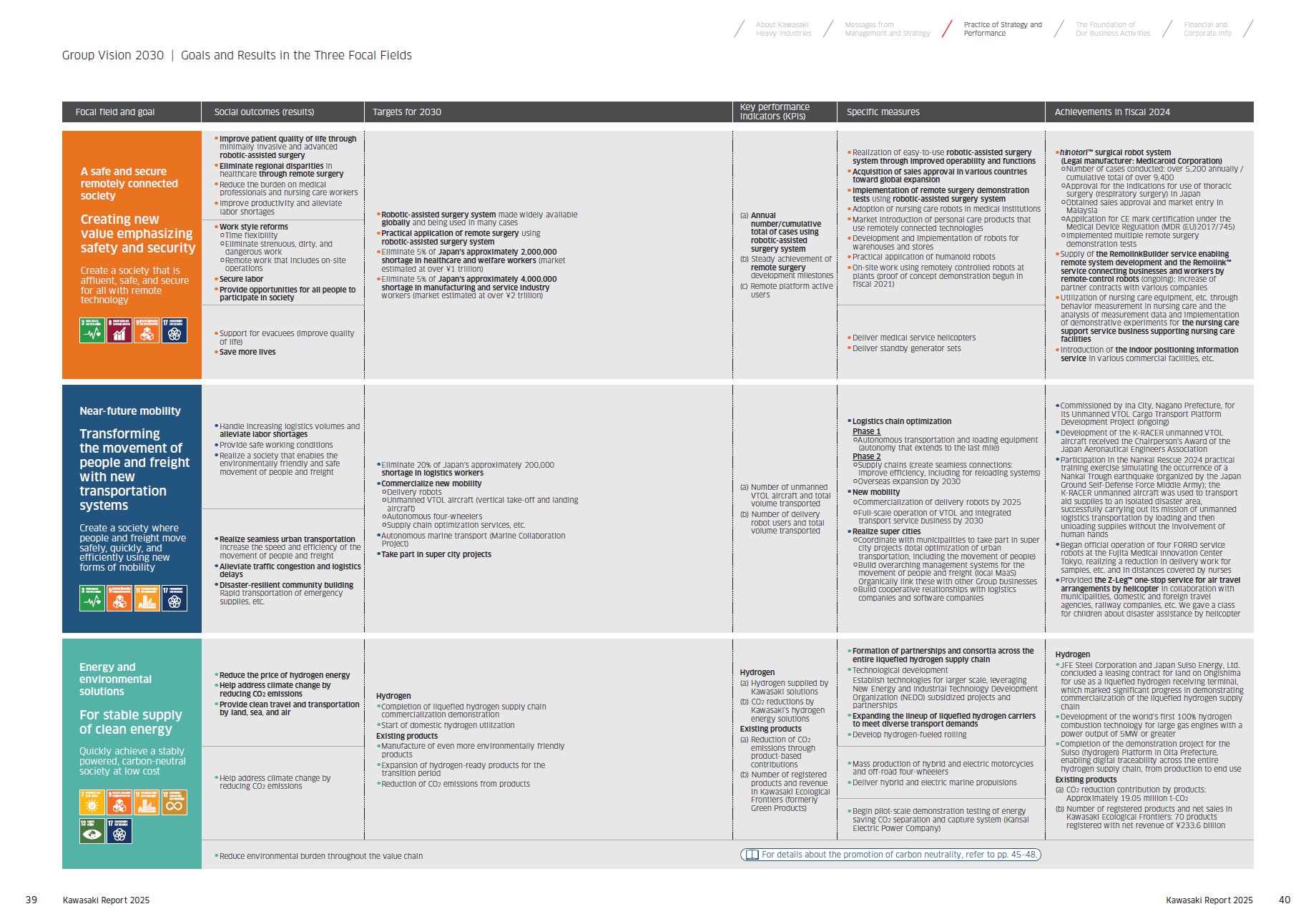
In the process of identifying material issues, the Kawasaki Group positioned three focal fields in our Group Vision 2030—“a safe and secure remotely connected society,” “near-future mobility,” and “energy and environmental solutions”—as the most important issues that our Group should challenge over the long term. We defined these topics as the “social and environmental value created through our business,” identified SDGs that the Group should contribute to, and set targets to reach by 2030. To maximize social and environmental value and achieve sustainable growth, we will contribute to the realization of the SDGs through our business by implementing measures in each of the three focal fields.
Targets and Results in the Three Focal Fields
* Click the image below to open the PDF file.
KPIs and Results for “The Foundation of Our Business Activities”
Within the Kawasaki Group, we positioned business and human rights, promotion of human resource activities, compliance, technology development, and DX, which serve as fundamental matters for achieving the three focal fields identified as the most important issues, as priority matters of the foundations of our business activities. We set quantitative targets and KPI for each item of the latter and are monitoring progress in our business activities.
Energy and Environmental Solutions (Value Chain)
Goals of Group Vision 2030
- Implement, to the maximum extent, feasible measures concerning Scope 3, to steadily work toward the milestone of becoming Zero-Carbon Ready by 2040.
| Priority matters | Target indicators (or key performance indicators) |
Fiscal 2024 results | Fiscal 2025 results |
|---|---|---|---|
|
Scope 3 (category (i))*1 | 4,604,237 t-CO2 | 5,188,466 t-CO2 |
| Scope 3 (category (xi)) *2 | 26,430,330 t-CO2 | 28,044,363 t-CO2 | |
| Initiatives to reduce category (i) of Scope 3 | Held carbon neutrality networking and seminars and started collecting information on emissions of suppliers |
|
*1 Kawasaki Heavy Industries, Kawasaki Railcar Manufacturing, Kawasaki Motors
*2 The Kawasaki Group
Promotion of Human Resources Activities
Goals of Group Vision 2030
- Strengthen and effectively use human capital (efficient allocation and human resource development) to achieve Group Vision 2030.
- Enhance employee engagement and build a company culture in which employees can continue to work with enthusiasm.
- Promote diversity, equity, and inclusion (DE&I) to build an organization in which a wide array of employees can maximize their individuality and potential.
| Priority matters | Target indicators (or key performance indicators) |
Fiscal 2024 results | Fiscal 2025 results |
|---|---|---|---|
|
ROI from human resources *1, *2 | 1.76 | 1.67 |
| Ratio of employees for whom both “engagement (job satisfaction)” and “enablement (productive work environment)” are high (employee engagement survey results) | 31%*5 | 36%*6 | |
| Proportion of women in managerial positions*4 | 2.5% | 2.6% | |
| Rate at which women, foreign nationals, and individuals with mid-career hires are promoted to senior manager or above*4 | 8.7% | 9.5% | |
| Wage differences between male and female employees*3 | 67.5% | 66.6% | |
| Rate at which male employees take childcare leave*4 | 29.6% | 45.6% |
*1 Calculated as sales - (sales expenses - employee-related expenses) / Employee-related expenses
*2 The Kawasaki Group
*3 The Kawasaki Group (domestic)
*4 Kawasaki Heavy Industries, Kawasaki Railcar Manufacturing, Kawasaki Motors
*5 Kawasaki Heavy Industries and 42 domestic consolidated subsidiaries
*6 Kawasaki Heavy Industries, 42 domestic consolidated subsidiaries, and 12 overseas consolidated subsidiaries
Occupational Safety and Health
Goals of Group Vision 2030
- Ensure that there are no serious occupational accidents Group-wide.
- Reduce the need for sick leave.
- Maintain and improve employee health.
| Priority matters | Target indicators (or key performance indicators) |
Fiscal 2024 results | Fiscal 2025 results |
|---|---|---|---|
|
Lost Time Injury Frequency Rate (LTIFR)*1*2 | 0.35 | 0.44 |
| Absence rate (day basis) due to sick leave*1*2 | 9.6 | 9.2 |
*1 Calendar year basis
*2 Kawasaki Heavy Industries, Kawasaki Railcar Manufacturing, Kawasaki Motors
Sustainable Supply Chain Management
Goals of Group Vision 2030
- Remain aware of environmental, human rights, and other risks associated with the entire supply chain and work with suppliers to promote sustainability.
| Priority matters | Target indicators (or key performance indicators) |
Fiscal 2024 results | Fiscal 2025 results |
|---|---|---|---|
|
Rate of major suppliers responding to our sustainable procurement survey | 82.3% (Responses from 200 companies of the total of 243) |
83.3% (Responses from 95 companies of the total of 114) |
| Implementation status of human rights due diligence | Identification of 9 supplier companies as targets for improvements based on the results of the sustainable procurement survey | Identification of 7 supplier companies as targets for improvements based on the results of the sustainable procurement survey |
Business and Human Rights
Goals of Group Vision 2030
- No violations of human rights throughout the value chain and no complicity in human rights violations.
| Priority matters | Target indicators (or key performance indicators) |
Fiscal 2024 results | Fiscal 2025 results |
|---|---|---|---|
|
Number of human rights impact assessments conducted for subsidiaries |
|
|
| Number of improvements and corrective actions based on SAQ*1 |
|
|
|
| Number of reports from outside stakeholders*2 | 19 | 29 |
*1 Self-assessment questionnaire (self-assessment sheet)
*2 Number of reports to supplier hotline and Japan Center for Engagement and Remedy on Business and Human Rights (JaCER) hotline
Product Liability/Safety
Goals of Group Vision 2030
- Deliver trustworthy and safe products and services from the customer’s perspective based on consistent quality policies by all employees, including top management.
| Priority matters | Target indicators (or key performance indicators) |
Fiscal 2024 results | Fiscal 2025 results |
|---|---|---|---|
|
Number of participants in TQM training | 4,947 persons (In addition, 12,880 participants in special training during the Continuous Improvement Awareness Month) |
5,310 persons (In addition, 910 participants in special training during the Continuous Improvement Awareness Month) |
| Number of certified TQM Internal Assessors*2 | 70 persons | 227 persons | |
| Certification status of quality management system*3 *4 | 73.1% | 75.0% |
*1 TQM: Total Quality Management
*2 TQM Internal Assessors are personnel who identify issues and opportunities for improvement through internal TQM assessments and drive continuous improvement activities within their business divisions.
*3 ISO 9001
*4 Total of domestic and overseas manufacturing sites
Technological Development/Digital Transformation (DX)
Goals of Group Vision 2030
- Deliver new products and new businesses to market which contribute to the resolution of global environmental and social challenges.
- Successfully acquire and utilize intellectual property rights linked with business strategies.
- Promote process innovation, increase sophistication of processes and integrate digital technologies throughout the value chain.
| Priority matters | Target indicators (or key performance indicators) |
Fiscal 2024 results | Fiscal 2025 results |
|---|---|---|---|
|
Number of cases of major external collaborations*1 | 11 cases Started joint research into absorbing CO2 from the air and trapping it in concrete, formally introduced an in-hospital delivery service using robots, etc. |
19 cases Signed a memorandum of understanding with NTT DOCOMO Business on a strategic collaboration aimed at realizing a connected society through the networking of robotics, mobility, and social infrastructure, etc. |
| Number of patents held*2 | Japan: 3,188 patents Overseas: 4,637 patents |
Japan: 3,238 patents Overseas: 4,733 patents |
|
| R&D expenses | 48.9 billion yen | 56.8 billion yen | |
| Number of personnel trained as DX promotion human resources |
|
|
*1 Number of cases disclosed in news releases
*2 Calendar year basis
Information Security
Goals of Group Vision 2030
- Maintain and manage cyberattack response and the protection of customer and product information with the world's highest level of security.
| Priority matters | Target indicators (or key performance indicators) |
Fiscal 2024 results | Fiscal 2025 results |
|---|---|---|---|
|
Information security training participants | 20,274 persons | 26,396 persons |
| Number of persons subject to training drills using simulated targeted attack phishing emails | 10,560 persons | 8,157 persons | |
| Interruption of production activities due to cyberattacks: 0 incidents | 0 incidents | 0 incidents |
Compliance
Goals of Group Vision 2030
- Monitor as accurately as possible the risks of committing compliance violations.
- Build an inclusive and effective compliance system tailored to given risks, and continuously manage and regularly update this system.
| Priority matters | Target indicators (or key performance indicators) |
Fiscal 2024 results | Fiscal 2025 results |
|---|---|---|---|
|
Attendance rate for compliance training for overseas | 90.75% | 82.06% |
| Number of whistle-blowing system reports | Japan: 92 reports/Overseas: 4 reports | Japan: 114 reports/Overseas: 3 reports | |
| Number of cases of compliance violations | Japan: 15 cases/Overseas: 1 case | Japan: 20 cases/Overseas: 0 |
Contact
If you need more information about our business,
please feel free to contact us.