
Risk Management
Approach to Risk Management
Stance on Risk Management
As a Group that operates globally across a wide range of fields, Kawasaki regards the management of serious risks that could impede its business activities as important. Kawasaki's overall risk management system entails the integrated execution of business segment-level risk management and Group-wide risk management. Based on the Group's Risk Management Regulations, Kawasaki has established a Group-wide enterprise risk management framework and created manuals outlining specific risk management procedures. By comprehensively understanding potential risks based on shared Group standards, we work to avoid and minimize risks and loss caused by risks. With regard to the risks associated with the execution of individual businesses, the relevant divisions carry out assessments and analyses and sufficiently examine countermeasures in advance in accordance with Kawasaki’s Board of Directors Regulations,Management Committee Regulations, Approval Regulations, and other related rules. The Company practices even more thorough risk management for major projects with significant impact on operations in accordance with such corporate regulations as the Major Project Risk Management Regulations. This includes management at the time of bidding and concluding agreements for such projects as well as regular follow-up by the Head Office and business segments as needed after a project begins.
Kawasaki Group Policy on Risk Management
In line with its objective of achieving sustainable corporate growth and medium- to long-term improvement in its corporate value, the Kawasaki Group will put in place preemptive risk management measures against a variety of risks that could exert a significant impact on business operations while striving to ensure that, should such a risk materialize, the resulting damage is minimized. To this end, the Group established the Kawasaki Group Policy on Risk Management with the aim of acting as a company worthy of the trust of society.
Scope of Policy Application
Our Group officers and employees

Risk Management System
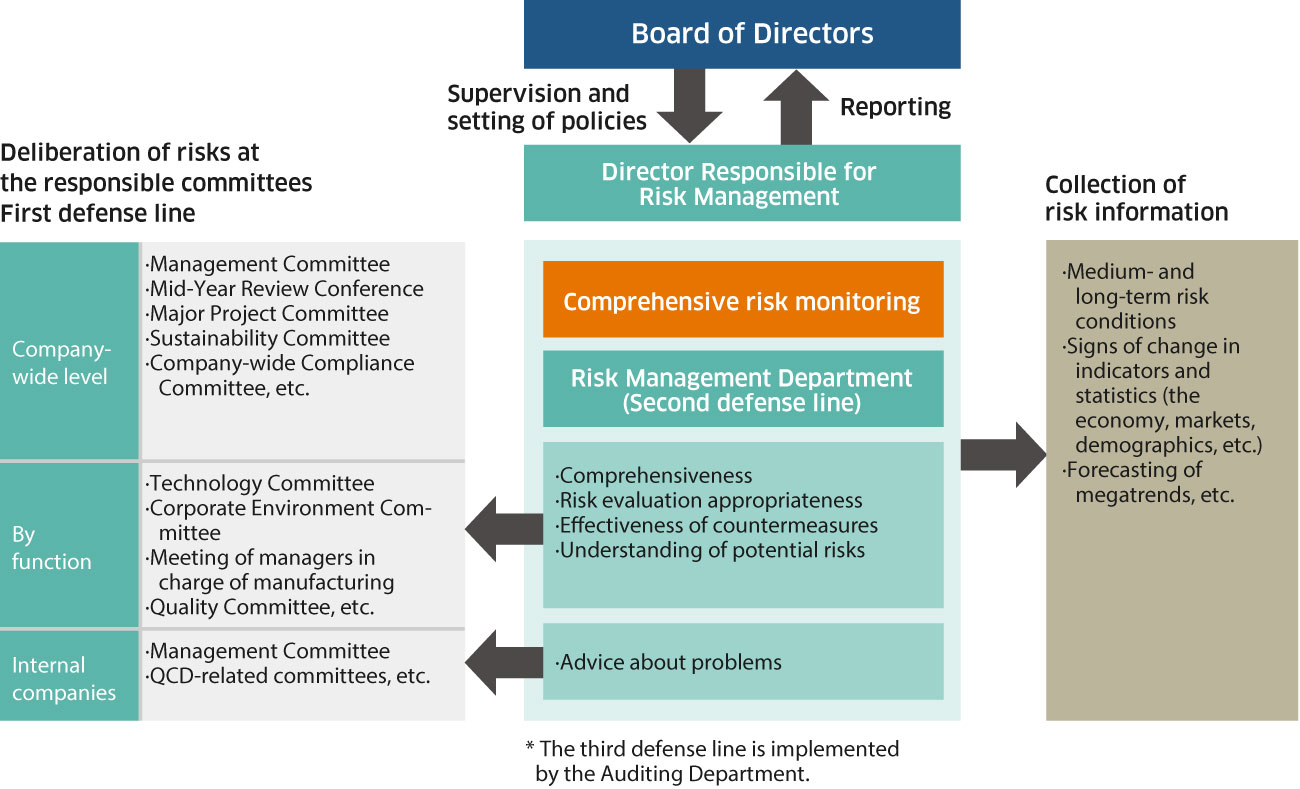
In today’s world, characterized by a societal and business environment which is changing dynamically due to factors including political and economic trends and climate change, managing risks accurately as part of daily business operations is essential. The Kawasaki Group has thus established a Group-wide enterprise risk management (ERM) framework to identify and respond to major risks with the potential to have serious impacts on our operations and is working to enhance risk management as outlined in the Kawasaki Group Management Principles. Additionally, we have established a secretariat function within the Risk Management Department at the Head Office’s Corporate Planning Division for the promotion and support of Group-wide risk management in collaboration with all Head Office departments. At the same time, each business segment has created an equivalent framework, with the business division managers designated as the responsible officers, thereby supporting our Group-wide management activities. To enable the appropriate handling of diverse risks, Kawasaki has established and is making effective use of management methods and systems under the Group-wide ERM framework, with Company-wide/functional internal committees and internal divisions of each business segment designated as the first-line risk owners, according to the type of risk. In addition, the Risk Management Department, which fulfills the second-line role, has devised a system for centralized monitoring of the effectiveness and workability of respective management systems, by which means we manage risks on both an individual and an integrated basis. Furthermore, the Risk Management Department compiles analysis reports on our risk management status and global risk trends surrounding the Company through risk monitoring, and the director responsible for risk management reports this information to the Board of Directors two times annually. After the Board of Directors deliberates and selects the important risks that the Company should pay close attention to currently, those risks are reported to the Management Committee and reflected in our business measures. In order to deliberate and promptly address any rapidly emerging risk from the recent geopolitical issues as well as climate change, governmental and economic instability, Board of Director meetings are held on an as-needed basis. In addition, the Audit Group, which is the internal audit department at Kawasaki, fulfills the third-line role, in which it assesses the effectiveness of the organization’s risk management and governance.
Risk Management System
Responsible Officers
Director Responsible for Risk Management (CRO): Katsuya Yamamoto, Representative Director, Senior Corporate Executive Officer
Executive Officer Responsible for Risk Management: Hideki Hiramatsu, General Manager of Corporate Planning Division and Executive Officer
Responsible Organizations and Committees
As part of supervision side activities, the Risk Management Department monitors risks and reports on the outcomes of its monitoring to the Board of Directors. Meanwhile, as part of execution side activities, we have established the Management Risk and Crisis Management Committee to share initiatives for responding to risk among departments and promote horizontal ties, with the aim of advancing risk management activities. The Management Risk and Crisis Management Committee is chaired by the General Manager of the Corporate Planning Division, who also serves as the Executive Officer Responsible for Risk Management, with the Senior Manager of the Risk Management Department, the division managers of relevant departments at Head Office, and the senior managers responsible for Risk Management in respective business segments sitting on the committee.
Risk Assessment
Risks Covered and Risk Assessment Methods
The Kawasaki Group defines risks as "factors or phenomena that hinder the execution of business operations or the achievement of organizational goals" and works to manage all risks classified as either external risks or internal risks (with the latter further classified as strategic risk or business risk), while giving due consideration to the positive effects associated with strategic and other risks. The Group’s risk management process consists of a version of the COSO framework and ISO 31000, customized for the Group’s environment and circumstances. Risk monitoring activities are reported to the Board of Directors two times a year, and the Board selects and sets priority risks that the Group should pay close attention to currently, and based on the results, feedback is provided to the departments at risk. Further, for items judged to be high risk by the Board, we focus on risk monitoring activities called “checking the appropriateness of risk management activities.”
Risk Factors Currently Covered in the Scope of Risk Management
| Types of risks | |||||
|---|---|---|---|---|---|
| External Environment | Government/Regulatory authorities | Laws and regulations | Internal Environment | Business strategy | Vision (strategies and policies) Corporate governance, etc. |
| Financial institutions/Investors | Raising capital | Business functions | Legal affairs (contracts and lawsuits) Intellectual property, security, etc. |
||
| Market expectations | Management and efficiency | Project management Finance and accounting, personnel management, etc. |
|||
| Customers/Consumers/Competitor companies/New entrants | Emergence of competitors, market changes Technological innovation |
Technological innovation | Product development, etc. | ||
| Job seekers | Securing human resources | Product defects | Quality management and quality assurance, etc. | ||
| Suppliers | External procurement | Production capacity | Process control, etc. | ||
| Business partners | Supply chain and logistics | Governance and compliance | Organizational fraud, harassment, internal control etc. | ||
| Nature/Social culture/Population | Disasters, environmental pollution, SDGs, sustainability, climate change, biodiversity, etc. | ||||
Risks That the Group Should Pay Close Attention to Currently
As a result of company-wide monitoring activities in fiscal 2025, the Group has determined the following risks that should currently be paid close attention to in the order of severity.
| Priority risks to pay close attention to | Degree of severity (risk ranking) |
Hazard assessment | ||||
|---|---|---|---|---|---|---|
| Status of manifestation | Timing of impact | Impact on profit | Difficulty of taking action | |||
| Organizational culture/Governance (compliance, quality management) | Extremely high | 1 | Highest | Highest | Highest | High |
| Uncertainties in the international situation due to geopolitical risks, protectionism, and other factors | high | 2 | Highest | Highest | High | High |
| Supply Chain | High | 2 | Highest | Highest | High | High |
| Technological advances and misuse (AI and cybersecurity) | Medium | 4 | High | Highest | Medium | High |
| Digital transformation and AI utilization | Medium | 4 | High | Highest | Medium | High |
| Natural disasters in Japan | Medium-low | 6 | Medium | Medium | High | High |
| China/Taiwan relations | Medium-low | 6 | Medium | Medium | High | High |
Note: Timing of impact is set to “high” in cases where the period of impact until the impact manifests is short, and set to “low” when the period is long.
Four Perspectives in Assessments
| Assessment perspective | Assessment content |
|---|---|
| Status of manifestation |
|
| Timing of impact |
|
| Impact on profit |
|
| Difficulty of taking action |
|
Key Risk Response Status
| Risks to pay close attention to | Overview of risk | Risk response measures |
|---|---|---|
| Organizational culture and governance (compliance and quality management) |
|
|
| Uncertainties in the international situation due to geopolitical risks, protectionism, and other factors |
|
|
| Technological advances and misuse (AI and cybersecurity) |
|
|
Emerging Risks
The Kawasaki Group has positioned risks with the potential to have significant impacts on our business operations in the medium to long term (three to five years) due to changes in the external environment as emerging risks from among the risks that the Kawasaki Group should focus on in the immediate period, and conducts regular reviews of these emerging risks based on the outcomes of company-wide monitoring activities. The following is an overview of the major emerging risks, their potential impacts, and mitigation measures.
| Natural Disaster Risks in Japan | |
|---|---|
| Overview of risk | Japan is a country which is prone to frequent natural disasters, and in January 2025, the Japanese government revised upwards its prediction of the probability of the occurrence of a Nankai Trough earthquake or a massive earthquake centered directly under Tokyo, and is alerting the public to this probability. In recent years, Japan has experienced frequent and increasingly intense torrential rains, typhoons, and large-scale forest fires. In the case that a massive earthquake or other serious natural disaster occurs in Western Japan, the Kawasaki Group, which has its main bases in these regions, could be subject to serious damage, with the potential to significantly impact on business performance. |
| Potential impact | In addition to the physical damage to Kawasaki’s manufacturing site buildings and equipment and a halt to production activities, significant damage to social infrastructure can be anticipated as a result natural disasters such as earthquakes or tsunamis. For this reason, even in the case that Kawasaki’s own plants are restored quickly, the potential exists that it would take a long time for production activities to be normalized due to ongoing difficulties in the procurement of raw materials and parts owing to disruptions in the supply chain. Furthermore, as Kawasaki manufactures and sells products that support societal activities—such as power generation facilities including gas turbines, energy plants, and transportation equipment including rolling stock—delays in the restoration of production activities can be anticipated to significantly impact on the activities of Japan as a whole as well as those of local communities. |
| Mitigation measures | The Kawasaki Group has formulated a business continuity plan (BCP) and is enhancing the organization’s disaster response capabilities through regular BCP drills to enable business continuity in the event of a natural disaster. In terms of production activities, we are promoting measures such as the earthquake-proofing of facilities and the creation of sturdy supply chains toward the minimization of damage. Furthermore, we are establishing a reconstruction support system in cooperation with local authorities toward the restoration of societal activities. Specifically, we will provide Kawasaki products that are of utility for reconstruction, including unmanned helicopters and off-road four-wheelers, and are establishing frameworks to enable us to quickly deploy support activities making effective use of these products in the event of a natural disaster. In addition, as for social infrastructure products, we have established a system to facilitate the continuous provision of our products and services even in the event of a disaster as critical businesses. |
| China/Taiwan Relations Risk | |
|---|---|
| Overview of risk | In recent years, the international community has been paying close attention to China/Taiwan relations due to concerns about their many impacts on political, economic, and security fronts. As we conduct business operations in China and Taiwan and have multiple production plants and marketing bases in this region, particularly in China, any disruption or torpor in logistics, due to Chinese governmental policies, relations among Japan, China, and the U.S., or political unrest in the vicinities of the Taiwan Strait, would have major impacts on our business. |
| Potential impact | In the case that China/Taiwan relations deteriorate, this has the potential to seriously impact on logistics and production, while restrictions on business operations have the potential to significantly impact on the earnings of local subsidiaries. While a large proportion of the Kawasaki Group’s business operations in China involve local production for local consumption and local production for export, a proportion of these are also incorporated into product manufacturing processes in Japan, and it can consequently be anticipated that such impacts would also affect production activities in Japan. |
| Mitigation measures | The Kawasaki Group’s basic policy for mitigation measures involves maintaining relationships of trust with our employees, customers, suppliers, government officials, and other stakeholders, and the continuation of our business in China and Taiwan from a long-term perspective. Based on this we are enhancing our information collection and analysis activities in collaboration with experts in Japan and overseas and establishing response plans aligned with respective levels of crises. In addition, for parts procured from our Chinese subsidiary or Chinese companies for our production sites in Japan, we are working to establish production systems that enable in-house production as needed and exploring alternative procurement options. We are conducting reviews of these measures as appropriate based on any changes in China/Taiwan relations. |
Risk Culture
Risk Management Training and Awareness Building
Kawasaki explains the importance of risk management in its grade-specific training programs for employees. In addition, our commitment to improving our enterprise value based on the guiding principles of “selective focusing of resources,” “emphasis on quality over quantity,” and “risk management” is clearly stated in the Kawasaki Group Management Principles, part of the Kawasaki Group Mission Statement. We also post the Mission Statement at work areas and distribute Mission Statement cards to employees to build awareness of these principles.
Risk Management Training for Directors and Executive Officers
Themed lectures on economic security and leadership in crisis management are conducted by experts approximately twice each year for members of the Board of Directors including Outside Directors as well as for members of the Management Committee. In addition, from the perspective of economic security, in light of developments concerning the protection of both civilian and advanced technologies that have military applications, which have deep implications for our business, we have been holding lectures for employees on topics such as business risks and crisis management in the context of geopolitical conditions, with the goal of protecting our employees and business operations from the rising risk of covert manipulation targeting employees for purposes of fraudulently using our business information.
Crisis Management
The Kawasaki Group's Risk Management Regulations contain crisis management provisions set out in readiness for the emergence of a risk. These regulations set forth behavioral guidelines and response systems that serve to protect lives and preserve assets, minimize damage and loss, and expedite the resumption of business activities in the event of unplanned interruption.
Basic Policy
Paragraph 3 of the basic policy of the Group’s Risk Management Regulations lays out the Kawasaki Group's policy for responding to crises. In addition to, of course, putting human lives first, the policy also clearly lays out the Company's priority of fulfilling its social responsibility as a company involved in infrastructure-related industries. Specifically, in the event of a major earthquake, we will help operate equipment used for disaster relief (such as aircraft and ships), work to quickly restore and maintain the operation of infrastructure (such as rolling stock, power generation facilities, and waste processing facilities), and support our customers and suppliers.
Crisis Management System (at Times of Crisis and Non-Crisis)
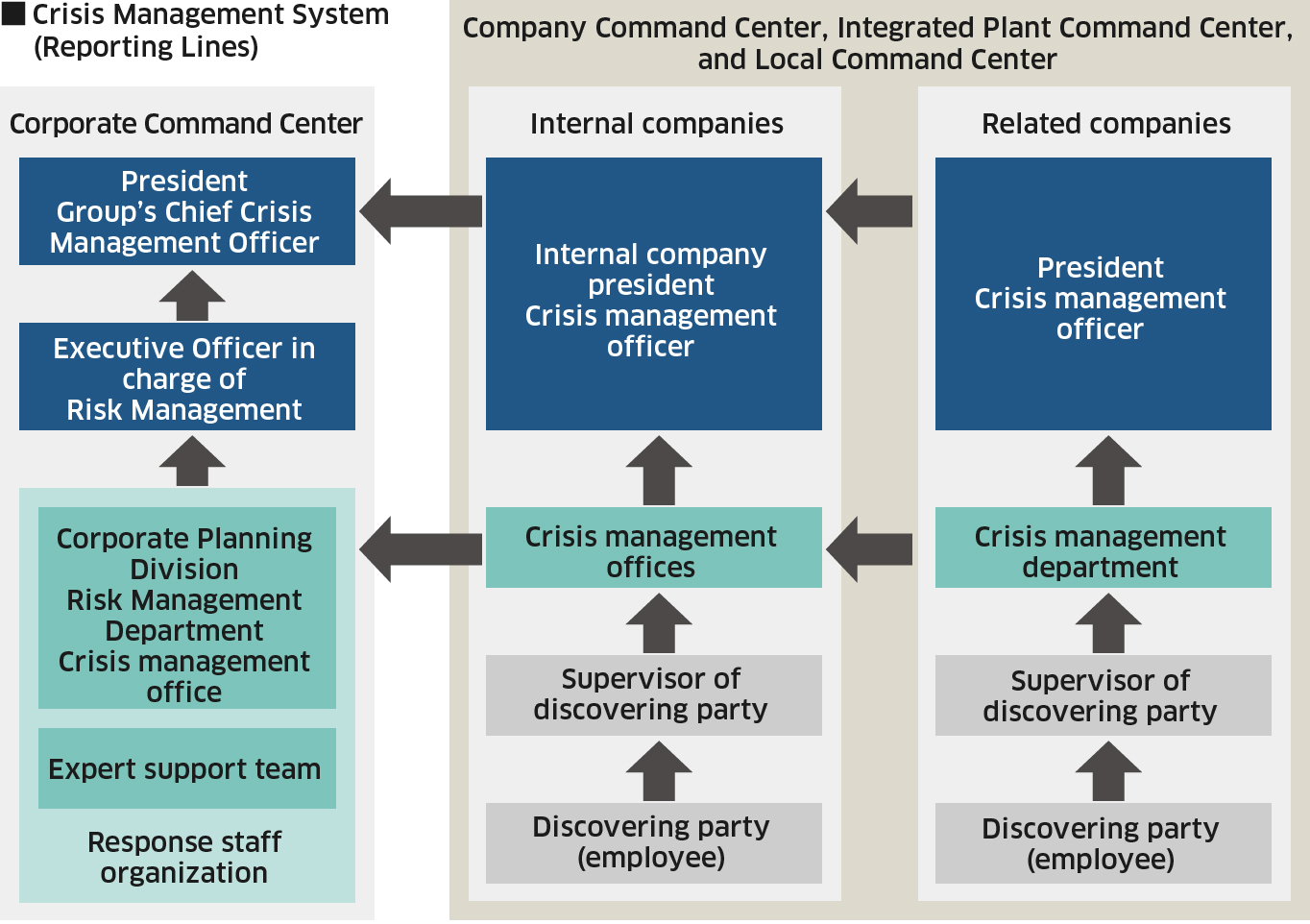
In readiness for any emergency which occurs, including large-scale disasters, we maintain a permanent Group-wide horizontally integrated Crisis Management Organization. The Crisis Management Organization maintains a structure whereby crisis management offices and specialized emergency response staff at Head Office are always in place, to ensure that we are positioned to respond swiftly and appropriately from the outset of any emergency. When a major emergency occurs, recovery efforts are carried out under the crisis management system, with the president serving as the Group’s Chief Crisis Management Officer and the head of each operating site or organizational unit acting as its crisis management officer, and with crisis management offices and the specialized emergency response staff of the Crisis Management Organization on duty to respond to the emergency.
In Times of Disaster or Accident (Emergencies)
The crisis management system sets out emergency reporting lines and organizations charged with responding when emergencies occur. Complementary to the emergency reporting lines, we have set up contact networks covering each business segment and operating site to ensure quick internal coordination and information promulgation.
Crisis Management System in Times of Disaster or Accident (Reporting Lines)
Emergency Communication System
The Kawasaki Group has introduced an emergency communication system for the entire domestic Group to rapidly confirm the safety of employees when a disaster occurs. Tests are conducted every year to ensure that the system is fully operational.
Business Continuity Plans
The Kawasaki Group positions business continuity plans (BCPs) as a management strategy. In addition to typical measures related to response in the immediate aftermath of a disaster, such as setting up disaster-prevention supplies and running evacuation drills, we also formulate and maintain BCPs in readiness for emergencies, including major earthquakes and pandemics, with the potential to disrupt business continuity, while considering ways in which to maintain our operations and fulfill our social mission.
Business Continuity Plan Review
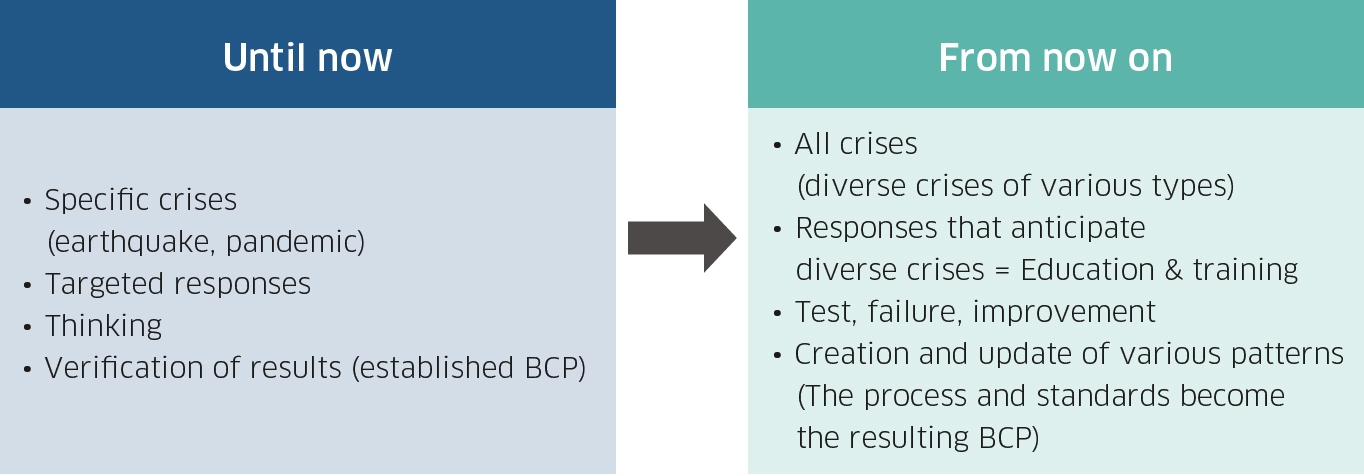
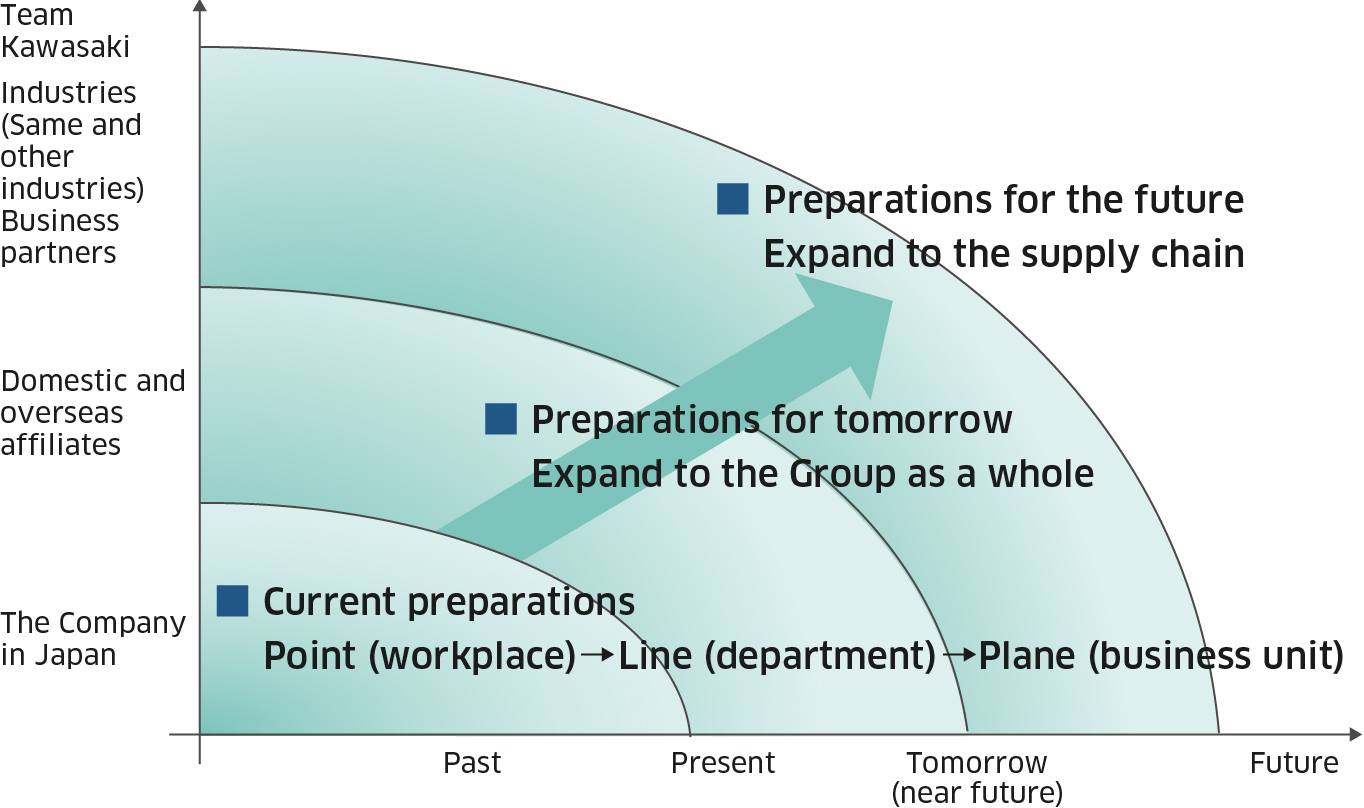
The lessons learned in the Great Hanshin Earthquake, which hit the Kobe area in January 1995, formed the basis of the Group’s disaster-prevention measures. In light of the Great East Japan Earthquake of March 2011, the Group significantly revised its BCP for large-scale earthquakes. In response to the COVID-19 pandemic in 2020, we have revised our pandemic response BCP to include, for example, remote working and other new workstyles. We are undertaking initiatives to expand the scope of our activities and enhance education and trainings toward the creation of a BCP capable of responding to “all crises,” rather than conventional activities that focused on “earthquake disasters and pandemics” as crises. These initiatives are being deployed to a backdrop of increasing global economy uncertainties with their origin in pandemics, conflicts, resource and new energy, and environmental issues, and based on demands from the Japanese government and other external parties.
- Basic Policy
Based on basic policy, determine course of action to be taken by the Kawasaki Group in the event of natural disasters. - Head Office and Each Business Segment Priorities
With the basic policy in mind, designate functions to be maintained at the Head Office and each business segment even in the event of disaster. To fulfill our corporate social responsibility and maintain business continuity at the Head Office and in each business segment, we have identified critical businesses for each business segment operating across multiple business fields as functions that must be maintained even in the event of a disaster. - Response in Times of Disaster and Preparation during Normal Times
Consider responses appropriate in the wake of disaster and prepare for the eventuality of such events during normal times. We are implementing measures to respond in times of disaster and preparation in normal times premised on a massive earthquake centered directly under Tokyo as well as a cascade-like triple megaquake event along the Tokai–Tonankai–Nankai segment of the Pacific Ocean coastline. To ensure the continuity of critical businesses and recovery for the entire business, each organizational unit evaluates supplies and alternative measures needed for business continuity and recovery, while also securing necessary supplies and formulating action plans. - Drills and Revisions
Run drills regularly and revise BCP content based on the results. We are striving to develop BCPs that minimize damage in the event of an emergency and enhance our ability to ensure business continuity while consistently running drills based on BCPs and revising BCP content based on the results of the drills.
Strengthen BCP Education and Training
Expand Scope of Action
Contact
If you need more information about our business,
please feel free to contact us.