
AI Ethics and Governance
- Management Approach
- Risk Management for Responsible AI Development and Use
- Initiatives to Create New Value
Management Approach
Our Basic Stance
The Principles behind Responsible AI Development and Use
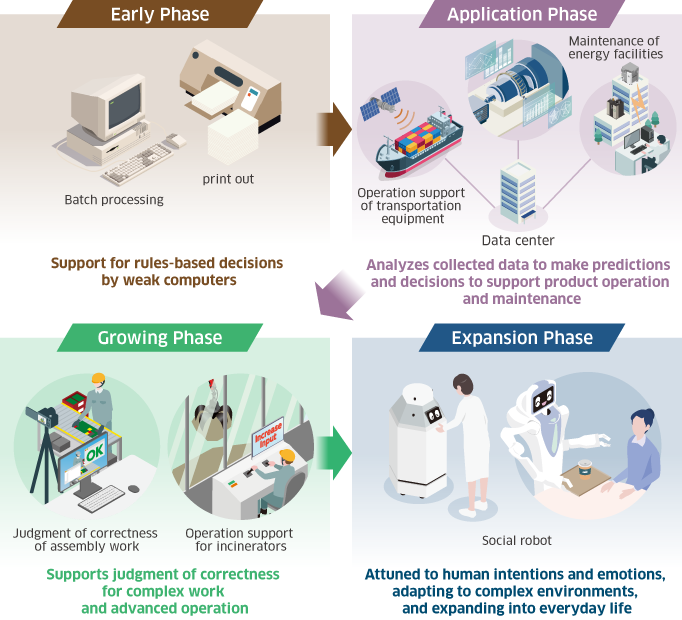
The use of AI is expanding across various sectors of society and industry. As this happens, we are seeing the advancement of products and services, the streamlining of operations, quality improvement, and the optimization of manufacturing processes. In recent years, advances in AI technologies, and particularly generative AI, have expanded their extensive use beyond research and development and specialized fields into corporate operations and everyday life. On the other hand, inappropriate development and use of AI have brought ethical and social challenges to light. These include human rights and privacy violations, the promotion of unfair discrimination and bias, a lack of accountability, the generation of misinformation, and concerns about the safety of autonomous products and systems. In response to this situation, countries and regions are moving forward to establish laws, regulations, and guidelines governing the development and use of AI. The Kawasaki Group has designated “working as one for the good of the planet” as its Group Mission. Furthermore, under Group Vision 2030: Trustworthy Solutions for the Future, we are committed to providing solutions to social challenges. Our Group has been engaged in research and development of AI-related technologies since the early days and has used them to solve technical challenges in our business activities. Examples include improvement of product performance and quality and optimization of manufacturing processes. As the scope of AI applications expands to include implementation in products and services, operational efficiency, quality improvement, and enhanced safety, our Group fully recognizes both value and risks that the use of AI has on society and business activities. We will promote the responsible development and use of AI while giving due consideration to human rights, privacy, safety, fairness, accountability, and environmental impact.
The Evolution of AI Development and Utilization in the Kawasaki Group
The Kawasaki Group AI Ethics Policy
While the Kawasaki Group is committed to contributing to the resolution of social issues by providing innovative solutions that leverage AI, we also believe it is important to fully recognize the impact that AI has on society, human rights, safety, and the environment, and to incorporate ethical considerations into the development and use of AI. Based on this approach, the Kawasaki Group established the Kawasaki Group AI Ethics Policy in July 2025, following approval by the Board of Directors. The policy defines the principles and requirements for the responsible development and use of AI.

Guidelines on the Development and Use of AI
Based on the Kawasaki Group AI Ethics Policy, our Group has established internal guidelines that define specific considerations and management processes for the development and use of this technology. The Guidelines for AI System Development define the risk management used in the planning, development, implementation, and operation of AI systems, while the Guidelines for the Use of Generative AI support the appropriate use of generative AI. Using them, we are incorporating the Kawasaki Group AI Ethics Policy in the day-to-day operations of each division and promoting the responsible development and use of AI.
AI Ethics and Governance Framework
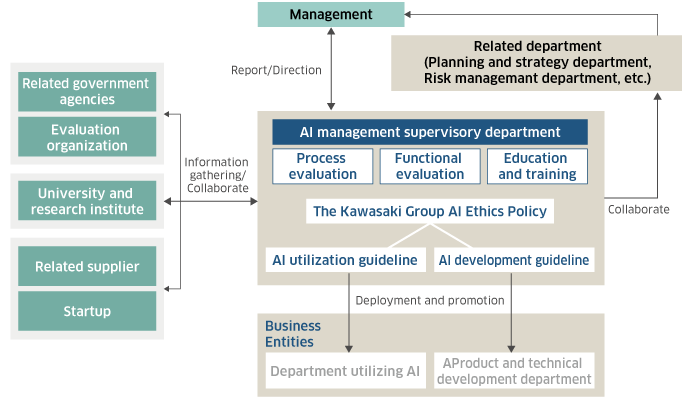
To strengthen governance in the development and use of AI, the Kawasaki Group has established a company-wide initiative led by the AI Management Division, under the direction of the Executive Officer Responsible for AI and with the Director Responsible for DX Strategy, who serves as the chief officer. The AI Management Division supports the appropriate development and use of AI across all divisions in accordance with the Kawasaki Group AI Ethics Policy, the Guidelines for AI System Development, and the Guidelines for the Use of Generative AI. In addition, the AI Management Division serves as a point of consultation for matters related to AI development and use, and works in collaboration with relevant divisions as needed to identify risks and consider response strategies. We have established a system for reporting risks associated with AI development and use, as well as the status of our responses, to the Management Committee and the Board of Directors as necessary.
AI Governance Promotion Framework
Responsible Officers
Director Responsible for DX Strategy (CIO): Hiroshi Nakatani, Representative Director,
Senior Corporate Executive Officer
Executive Officer Responsible for AI: Hironobu Urabe, General Manager of DX Strategy Division and Executive Officer
Responsible Executive Organ and/or Committee
Board of Directors / Management Committee
Risk Management in Responsible AI Development and Use
To appropriately manage risks related to AI, the Kawasaki Group conducts risk assessments at each stage—planning, development, implementation, operation, and improvement—in accordance with the Guidelines for AI System Development and the Guidelines for the Use of Generative AI under the governance framework described above. Specifically, we assess the purpose of use, scope of use, potentially affected stakeholders, impacts on society, human rights, privacy, safety, fairness, and other relevant areas. Based on our findings, we implement management measures tailored to the nature and severity of each risk.
Access Controls for High-Risk AI Functions and Sensitive Data
For AI functions such as facial recognition and surveillance that have the potential to significantly impact individuals’ rights and interests, as well as for AI systems that handle highly sensitive data, we verify the intended purposes and scope of impact. Based on our assessments, we take appropriate measures as necessary, such as limiting the scope of use, implementing access controls and usage restrictions, reviewing design policies, and exploring alternative approaches. Furthermore, we ensure the appropriate handling of data used in AI development and deployment by implementing access controls and usage restrictions in accordance with the intended purposes.
Fairness and Bias Assessment
When developing and using AI, we verify that no undue bias or discriminatory effects arise in the training data, output results, or usage scenarios. In particular, for AI that may affect human rights or the rights and interests of individuals, we conduct assessments of fairness and bias on a regular basis or as needed.
Ensuring Transparency and Accountability
When presenting AI-generated content or AI-based decisions, recommendations, or evaluation results to users and other stakeholders, we make every effort to clearly indicate AI’s involvement as necessary in order to prevent misunderstandings. We are also committed to ensuring accountability so that relevant stakeholders can understand the purpose of AI use, the context of the decision results, and important considerations regarding its use. In addition, we manage information on AI usage and decision-making processes so that it can be recorded and verified as necessary.
Post-Implementation Monitoring and Corrective Actions
Even after the AI systems go live, we continuously monitor such systems’ usage status, output results, accuracy, and any deviations from the intended operating environment. We strive to identify signs of declining model accuracy, changes in decision-making tendencies due to shifts in data or the operating environment, unexpected output patterns, bias, risks to human life and bodily safety, environmental risks, and other potential risks. If any such risks are identified, we conduct manual verification and assessment as necessary and implement corrective measures such as revising usage conditions, conducting additional verification, adjusting settings, retraining the model, or suspending use. We review these risk management and review processes as necessary, taking into account changes in AI technology, laws and regulations, social demands, and usage patterns both inside and outside the company. We then use the findings to improve guidelines, training content, and operational processes.
Objection Process
In cases in which the results of AI-based decisions, recommendations, or evaluations have an impact on users or third parties, we have established a system to verify the details, provide explanations, and conduct reviews as necessary through existing processes for handling inquiries, consultations, complaints, etc.
Reduction of Environmental Impacts
We recognize the increase in electricity consumption and computational resources associated with the development and use of AI as having one of the significant impacts on the environment. We are working to reduce the environmental impacts accompanying AI operation and training through efficient AI utilization, appropriate model selection, and collaboration with cloud service providers.
Education on and Awareness of the Development and Use of AI
Our Group regularly conducts e-learning training on the appropriate use of AI. We strive to instill responsible AI practices by ensuring that employees are aware of key considerations regarding information security, intellectual property, human rights, privacy, and other related matters.
Initiatives to Create New Value
The Kawasaki Group is working to create new value that contributes to solving societal challenges, with the aim of realizing its Group Vision 2030: Trustworthy Solutions for the Future. By making appropriate use of advanced technologies, including AI, the Group is promoting the provision of products and services that contribute to the realization of a safe, secure, and sustainable society.









Contact
If you need more information about our business,
please feel free to contact us.