Participation in External Initiatives
United Nations Global Compact
Kawasaki signed the United Nations Global Compact (UNGC) initiative proposed by the United Nations and was registered as a participating company in January, 2020. We have also joined the Global Compact Network Japan, the compact’s local network in Japan. The UNGC is a voluntary initiative for companies and organizations to act as good members of society and participate in creating a global framework for sustainable growth by taking responsible and creative leadership. In conducting their business operations, UNGC signatory companies and organizations are required to support the initiative’s ten principles in the four fields of human rights, labour, the environment, and anti-corruption.With our signing of the UNGC, we commit ourselves to promoting the ten principles in the four fields and continue our activities towards the realization of a sustainable society.
【The Ten Principles of the United Nations Global Compact】
| Human Rights | Principle 1: | Businesses should support and respect the protection of internationally proclaimed human rights; and |
|
| Principle 2: | make sure that they are not complicit in human rights abuses. | ||
| Labour | Principle 3: | Businesses should uphold the freedom of association and the effective recognition of the right to collective bargaining; | |
| Principle 4: | the elimination of all forms of forced and compulsory labour; | ||
| Principle 5: | the effective abolition of child labour; and | ||
| Principle 6: | the elimination of discrimination in respect of employment and occupation. | ||
| Environment | Principle 7: | Businesses should support a precautionary approach to environmental challenges; | |
| Principle 8: | undertake initiatives to promote greater environmental responsibility; and | ||
| Principle 9: | encourage the development and diffusion of environmentally friendly technologies. | ||
| Anti-Corruption | Principle 10: | Businesses should work against corruption in all its forms, including extortion and bribery. |

SBTi(Science Based Targets Initiative)
In August 2024, Kawasaki obtained certification from SBTi for its greenhouse gas reduction targets. SBTi is an international initiative founded in 2015 by CDP, the United Nations Global Compact, the World Resources Institute (WRI), and the World Wildlife Fund (WWF) to define and promote best practices for science-based target setting and independently evaluate corporate targets. The certified targets include two types based on fiscal 2022: a short-term target (NEAR-TERM) and a long-term target (NET-ZERO). Promoting various initiatives to achieve these targets, Kawasaki aims to achieve carbon neutrality across the entire value chain.

Please check the following link for further details.
TCFD (Task Force on Climate-related Financial Disclosures)
Kawasaki signed the statement of support for the TCFD recommendations in September, 2019. TCFD (Task Force on Climate-related Financial Disclosures) is a task force established by the Financial Stability Board, an international organization that includes central banks and financial regulators in major countries. Institutional investors and financial institutions who are investing in ESG emphasize that it is critical for companies to be aware of the risks and opportunities of climate change and incorporate them into their management strategies. They propose approaches to the appropriate disclosure of information regarding the risks and opportunities of climate change, which companies voluntarily disclose. We will communicate more clearly the Company's efforts to realize a sustainable society to our stakeholders, and work to further enhance information disclosure.

Please check the following link for further details.
GX Future League
Kawasaki Heavy Industries, Ltd. has been a member of the GX Future Consortium, whose secretariat is managed by the GX Acceleration Agency, and has participated in the GX Future League, which facilitates public-private rule-making to stimulate corporate-led GX demand and ensure financing, since 2026. The GX Future League is a framework aimed at realizing Green Transformation (GX), while promoting reductions in Scope 1 and Scope 2 emissions, encouraging investment in GX and the creation of GX products and services, and facilitating emissions reductions across the entire supply chain. Through initiatives such as developing a large-scale hydrogen supply chain to accelerate the realization of a hydrogen society and providing capacity building support for suppliers, the Kawasaki Group contributes not only to the achievement of carbon neutrality within the Group but also to carbon neutrality around the world.

For details, please refer to the following link.
Support for the Keidanren Challenge Zero
Kawasaki expressed its support for the Keidanren Challenge Zero initiative in March 2021. Challenge Zero (Challenge Net Zero Carbon Innovation) is a new initiative of the Japan Business Federation (Keidanren) undertaken in collaboration with the Japanese government to strongly promote in Japan and overseas and support innovative action by companies and other organizations to achieve a decarbonized society, which is positioned as the long-term objective of the Paris Agreement, an international framework for addressing climate change. Kawasaki has listed two initiatives: realization of international liquefied hydrogen energy supply chain and development of hydrogen fueled power generation technologies.

For details on Kawasaki’s Challenge Zero initiatives, please refer to the following link.
Kawasaki Supports My Declaration of Human Rights of Ministry of Justice
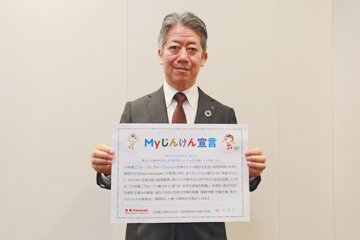
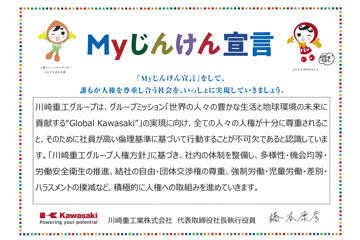
In July 2021, Kawasaki expressed its support for the My Declaration of Human Rights promoted by the Ministry of Justice.
The Declaration is an initiative for working toward a society where the human rights of all people are respected through companies, organizations, and individuals declaring that they will act in ways that respect human rights.
In accordance with the Kawasaki Group Policy on Human Rights , the Kawasaki Group is establishing internal systems and actively taking measures to address important human rights issues. Such measures include protecting diversity, equal opportunity, and occupational safety and health, approving freedom of association and the right to collective bargaining, and prohibiting forced labor, child labor, discrimination, and harassment.
For details on My Declaration of Human Rights, please refer to the following link.
Contact
If you need more information about our business,
please feel free to contact us.