
First in Japan to Validate a Hydrogen Aircraft Engine Capable of Achieving One of the World's Lowest NOx Emission Levels
Oct. 08, 2026
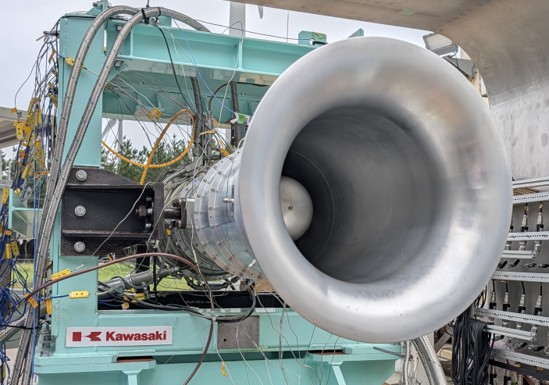
Tokyo, October 8, 2026 – Kawasaki Heavy Industries, Ltd. announced today that it has successfully completed Japan’s first operational test of a small aircraft engine equipped with a newly developed hydrogen combustor that achieves one of the lowest nitrogen oxide (NOx) emissions in the world. The test was conducted as part of the “Development of Core Technologies for Hydrogen Aircraft” Project (hereinafter “Project”), which was selected by the New Energy and Industrial Technology Development Organization (NEDO) and subsidized as one of its Green Innovation Fund projects, “Next-Generation Aircraft Development.” The achievement marks an important milestone in the development of propulsion technologies for future hydrogen-fueled aircraft.
The project aims to develop hydrogen combustion technologies and related systems for practical use in hydrogen-fueled aircraft engines. For this latest test, a small aircraft engine was equipped with Kawasaki's newly developed low-NOx hydrogen combustor and operated using 100% hydrogen fuel. The test was conducted at the Japan Aerospace Exploration Agency (JAXA) Noshiro Rocket Testing Center in Akita Prefecture. Stable combustion and thrust generation were confirmed throughout a full range of engine operations, including ignition, engine spool-up, steady-state operation corresponding to cruise conditions, transient acceleration and deceleration, and engine shutdown.
The newly developed combustor applies Kawasaki's proprietary micromix combustion technology, originally developed and commercialized for power generation gas turbines, to hydrogen aircraft engines. The technology distributes hydrogen combustion among numerous micro-flames, suppressing the formation of local high-temperature regions and thereby significantly reducing NOx emissions.
The test verified both the operational stability required for aircraft engines and low-NOx performance. Results obtained from the test indicate the potential to achieve one of the world's lowest NOx emission levels while complying with increasingly stringent aircraft engine emissions regulations established by the International Civil Aviation Organization (ICAO).
The test was carried out as part of development activities for hydrogen aircraft engine combustor and system technologies. Kawasaki has previously conducted operational tests of a small hydrogen-fueled aircraft engine as well as demonstration testing of a liquefied hydrogen fuel storage tank. Based on the results of this latest test, Kawasaki will further accelerate the development of key technologies required to achieve hydrogen-fueled aircraft.
The project adopts a core technology development period of 2021 to 2030. Kawasaki plans to implement verification ground testing to evaluate the feasibility and performance of an integrated system incorporating aircraft, engines, fuel tanks, and related technologies.
By combining its long-standing expertise in aircraft engines with hydrogen-related technologies, Kawasaki intends to promote emission reductions in the aviation sector by realizing hydrogen-fueled aircraft, and at the same time, contribute to achieving a carbon-neutral society by 2050 through hydrogen initiatives, including the “Liquefied Hydrogen Supply Chain Commercialization Demonstration Project.”