
Bulk Carrier ARISTOS II Delivered
Jul. 30, 2026
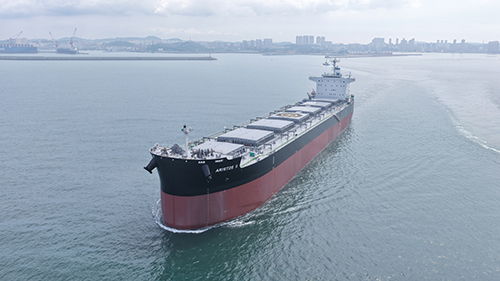
Tokyo, July 30, 2026 — Kawasaki Heavy Industries, Ltd. announced that it delivered the bulk carrier ARISTOS II, with a capacity of 82,000 DWT (Kawasaki hull No. 8108, DACKS hull No. 169) for SANTA MARINE INC. at Dalian COSCO KHI Ship Engineering Co., Ltd. (DACKS), which is located in Dalian, China and operated jointly with China COSCO Shipping Corporation Limited (China COSCO Shipping).
Principal particulars and features of the vessel are as described below.
| Principal Particulars | |
|---|---|
| Length overall | 228.90 m |
| Molded breadth | 32.24 m |
| Molded depth | 20.20 m |
| Molded draft | 14.55 m |
| Gross tonnage | 44,139 T |
| Deadweight | 82,766 t |
| Hold capacity | 98,269.9 m3 |
| Main engine | One set of MAN B&W 6S50ME-C9.7-HPSCR diesel engine |
| Speed | Approx. 14.2 knots |
| Complement | 25 people |
| Classification | ClassNK |
| Country of registration | Panama |
| Delivery | July 30, 2026 |
Features
- The vessel has a flush deck with a forecastle and seven holds that are capable of carrying cargo such as grain, coal and ore.
- The vessel employs various technologies to achieve maximum fuel economy, including an energy-saving, electronically controlled main diesel engine, high propulsive efficiency propellers, the Kawasaki rudder bulb system with fins, and the semi-duct system with contra fins, achieving a reduction equivalent to the IMO’s Energy Efficiency Design Index (EEDI)*1 Phase 3 regulations (30% reduction in CO2 emissions from the baseline).
| *1 | Energy Efficiency Design Index (EEDI) regulation: An international regulation that enforces compliance of newly-constructed vessels with energy-saving performance regulation values using the Energy Efficiency Design Index (EEDI), which is defined as the number of grams of CO2 emitted when transporting one ton of cargo over one mile. Required EEDI regulation values are made stricter in phases according to the construction contract and delivery dates. For bulk carriers, compliance with Phase 2 set in 2013 (20% reduction in CO2 emissions from the baseline [Phase 0]) is required for vessels contracted for construction in 2020 and later. In addition, compliance with Phase 3 (30% reduction in CO2 emissions from the baseline [Phase 0]) is required for vessels contracted for construction in 2025 and later. |
Contact
If you need more information about our business,
please feel free to contact us.