
Kawasaki Launches Collaboration with NVIDIA to Realize a “Next-Generation Digital Shipyard” — Leveraging AI and Digital Twin Technology to Advance DX in Commercial Shipbuilding —
Jul. 16, 2026
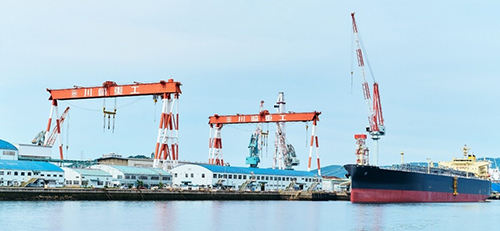
Tokyo, July 16, 2026 — Kawasaki Heavy Industries, Ltd. today announced that its collaboration with NVIDIA Corporation (headquartered in California, U.S.) has begun to realize a next-generation digital shipyard using physical AI and digital twin technology in shipbuilding.
Through this collaboration, Kawasaki will combine the extensive data and expertise it has accumulated over many years at shipbuilding sites, together with its advanced technological capabilities in robotics, with NVIDIA’s sophisticated AI, robotics, and digital twin technologies. By combining these strengths, the two companies will aim to build a production system for a next-generation shipyard that connects every stage from the design to the construction of commercial vessels in a single, seamless flow at the Sakaide Works.
Japan’s shipbuilding industry currently faces serious challenges, including a declining number of skilled workers and labor shortages driven by the falling birthrate and aging population. At the same time, global efforts to reduce environmental impact are driving worldwide demand for low- and zero-carbon vessels, making it an urgent priority for the shipbuilding industry as a whole to expand construction capacity and improve productivity.
To address these challenges, Kawasaki has been working to expand shipyard construction capacity and improve productivity through the promotion of digital shipyards,*1 realized through digital transformation (DX) in commercial vessel construction, and through the development of AI robots*2 for shipyards, carried out as part of the government-supported “Technology Development Project to Realize Next-Generation Shipyards through the Use of AI”. Building on these efforts, this new collaboration with NVIDIA will make use of NVIDIA’s physical AI stack (NVIDIA Cosmos™, NVIDIA Omniverse™, NVIDIA Isaac™, NVIDIA Metropolis, NVIDIA Jetson™, etc.) to advance a next-generation shipyard model that integrates robotics, AI, autonomous systems, digital twins, and simulation technology. This will contribute to improving the productivity of Japan’s shipbuilding industry and to establishing a stable system for vessel supply. Looking ahead, Kawasaki will pursue the use of physical AI across the entire lifecycle of a vessel, extending beyond the construction process to operation, maintenance, and servicing.
Key Initiatives of This Collaboration
Building on the commercial vessel DX / digital shipyard initiatives that Kawasaki has been advancing, the two companies will examine the implementation of, and pursue further advancement in, the following areas.
- Building a Next-Generation Digital Shipyard (Further Advancing Efforts to Expand Construction Capacity and Improve Productivity)
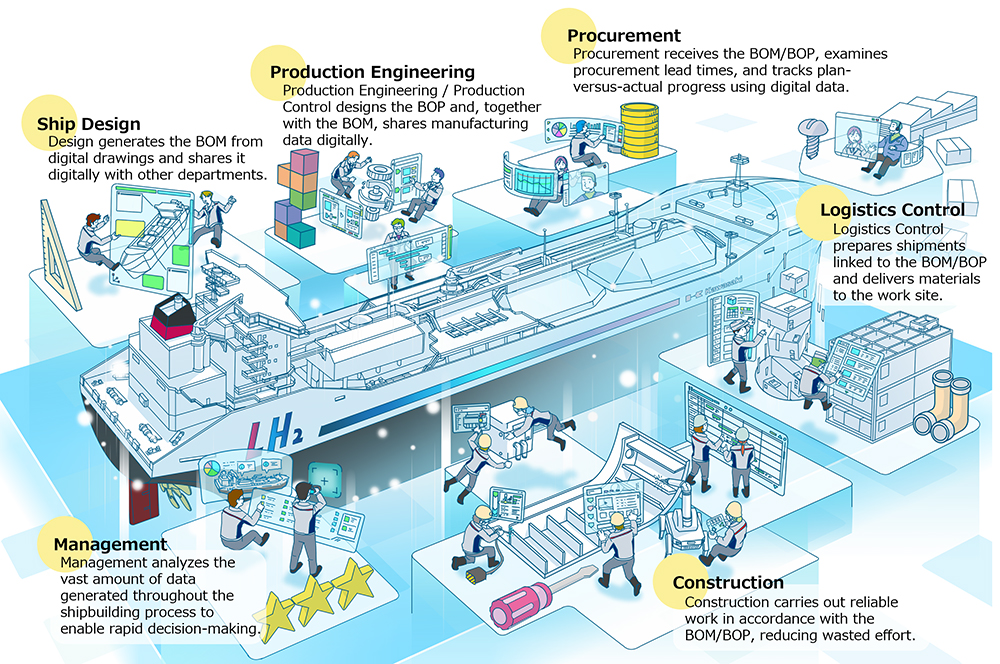
Kawasaki will further advance the commercial vessel DX (shipbuilding based on BOM/BOP*3) it has been promoting by making greater use of digital twin technology, minimizing the risk of redoing work, and optimizing processes. - Building an Environment for Introducing AI and Robotics to Shipyards and Strengthening Integration with On-Site Data
Kawasaki and NVIDIA will jointly build a framework for rapidly introducing Kawasaki-developed robots into shipbuilding operations (such as welding, painting, inspection, and material handling) through motion planning, path generation, simulation, and on-site applicability verification. In addition, the two companies will build a system that uses real-world shipyard environment data and construction/inspection data together with AI solutions to optimize robot operating conditions and continuously improve the accuracy of quality assessments. - Improving Shipbuilding Process Efficiency through Agentic AI
Agentic AI will be used to support work across shipbuilding processes such as design, procurement, manufacturing, and quality management, thereby improving productivity. - Application to the Vessel Lifecycle (Operation and Maintenance)
Kawasaki will examine a framework for connecting data generated during construction to post-delivery operation, maintenance, and refit work, and for feeding that information back into maintenance services.
Kawasaki will advance these initiatives through phased demonstration and implementation. The company will first carry out technology verification and identify on-site challenges in commercial vessel construction centered on the Sakaide Works. Kawasaki then aims to apply the knowledge gained through these efforts to other large structures and manufacturing sites, while also contributing to greater efficiency in the operation and maintenance of vessels after delivery.
Comments on This Collaboration
“Shipbuilding is one of the world’s most complex forms of manufacturing, and physical AI is opening a new era in how vessels are designed and built, by combining Kawasaki’s shipbuilding expertise and field data with NVIDIA Omniverse libraries, Cosmos world models and the Isaac platform, Kawasaki can connect design to the shipyard floor, train and validate AI robots in simulation, and help create more efficient, next-generation shipyards.”
NVIDIA Corporation
Vice President of Robotics and Edge AI Deepu Talla
“Our collaboration with NVIDIA marks an important step in advancing the use of AI in shipbuilding to a new stage. By combining the shipbuilding technology we have cultivated over many years with NVIDIA’s advanced AI and simulation technology, We will achieve more sophisticated design, production optimization, and skills transfer, while taking on the challenge of creating new value to support the shipbuilding industry of the future.”
Kawasaki Heavy Industries, Ltd.
President, Representative Director and CEO Yasuhiko Hashimoto
| *1 | An initiative that leverages the latest digital technologies to streamline and optimize the entire process, from vessel design through construction and operation. |
| *2 | Kawasaki Heavy Industries, “Selected for the ‘Technology Development Project to Realize Next-Generation Shipyards through the Use of AI’ — Promoting R&D of Next-Generation Shipyard Robots Based on Physical AI —” (April 21, 2026) https://www.khi.co.jp/news/news_260421-2.pdf |
| *3 | Bill of Materials (BOM): information related to parts and components. Bill of Process (BOP): information related to work processes. |
Related links
Kawasaki Collaborates with NVIDIA, Analog Devices, Microsoft, and Fujitsu to Accelerate Development of Physical AI toward Social Implementation. — Establishment of a Physical AI Development Hub in Silicon Valley, USA — (May 22, 2026)
https://global.kawasaki.com/en/corp/newsroom/news/detail/?f=20260522_8524
Contact
If you need more information about our business,
please feel free to contact us.