
Combined Cycle Power Plant (CCPP)
Achieving world-class efficiency through the power of “All-Kawasaki”
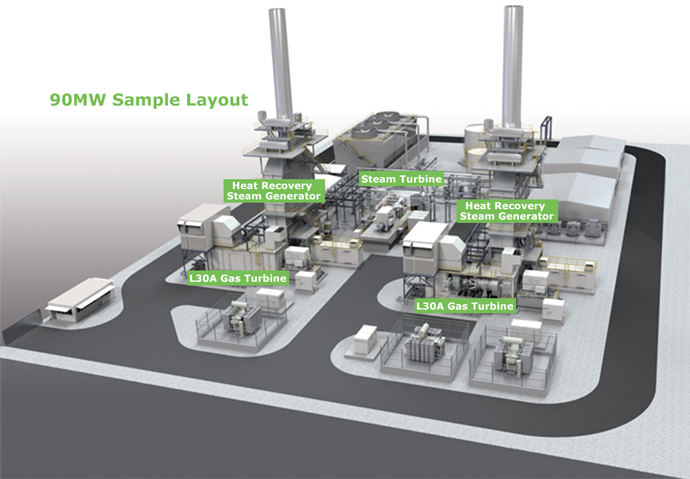
Fully developed using Japan’s advanced domestic technologies, Kawasaki Heavy Industries’ Combined Cycle Power Plants (CCPP) deliver world-class thermal efficiency, helping you reduce energy costs and pave the way toward carbon neutrality.
A key strength of our CCPP is the ability to deliver an “All-Kawasaki” approach, in which all major components— including the gas turbine, heat recovery steam generator and steam turbine—are manufactured in-house. This ensures seamless system integration, high reliability, and consistent performance across the entire system.
What are Combined Cycle Power Plants?

A Combined Cycle Power Plant (CCPP) is a high-efficiency thermal power generation system that produces primary electricity through a gas turbine. The high‑temperature waste heat from the gas turbine is then diverted to a heat recovery steam generator, where it is used to produce steam that drives a steam turbine for secondary power generation. This use of an energy cascade*1 allows the maximum amount of electric power to be extracted from a fuel source. Through this multistage utilization of heat—known as an energy cascade*1—CCPPs maximizing the amount of electric power extracted from the fuel source.
Compared with conventional boiler-and-steam-turbine power plants of the same output, CCPPs boast shorter startup times, superior load-response capability and higher overall efficiency, resulting in less waste heat and improved operational flexibility.
Kawasaki’s CCPPs are available in configurations ranging from 10–90 MW, built around our full lineup of in-house-developed gas turbines—from the 8 MW-class M7A to the 32 MW-class L30A—as the key hardware component. In addition, by selecting either extraction or back-pressure steam turbines, the heat-to-power ratio can be adjusted, allowing optimal capacity design tailored to the specific power demand, steam demand, and energy intensities of each plant or facilities.
*1: The staged use of heat or energy across multiple stages and applications, such as power generation or steam production.
Key Components of Kawasaki’s CCPP
Japan-made High-Efficiency Gas Turbines

The gas turbines at the core of our CCPPs are fully developed, designed and manufactured in-house. As purely Japan-made High-Efficiency gas turbines with no black-box components, we offer outstanding reliability.
Our main product lineup includes the M7A (8MW class), L20A (20MW class), and our highest-output model, the L30A (30MW class). With a power generation efficiency of 40.6%, the L30A is the world’s most efficient gas turbine in the 30MW class. It also delivers excellent operational performance with a 6-year Time Between Overhauls (TBO).
Heat Recovery Steam Generator (HRSG)
with Excellent
Installation
Flexibility

Left: vertical type / Right: horizontal type
The Heat Recovery Steam Generator (HRSG) is a critical component of CCPP that generates steam by utilizing exhaust heat from the gas turbine. With over 70 units delivered across a wide variety of plants, Kawasaki has an extensive track record and proven reliability.
We offer both horizontal and vertical natural-circulation HRSGs, allowing you to select the optimal configuration based on the application and requirements of the installation site.
In particular, the vertical-type HRSG features a smaller installation footprint and offers superior ease of assembly and installation. We are also advancing development with a view toward future hydrogen utilization.
Japan-made Steam Turbines Developed
with Fully
In-House
Technology

Kawasaki steam turbines for power generation are distinguished by our fully in-house technology, covering every stage from development to manufacturing.
Through custom-designed specifications tailored to each customer’s steam conditions and operations requirements, we achieve both maximum efficiency and optimal performance. We support a wide range of turbine configurations—including condensing, reheat, extraction-condensing, and extraction-back-pressure types—enabling optimal heat-to-power balancing in cogeneration systems.
With delivery records ranging from 600 kW to 151,500 kW, our power generation steam turbines have earned high recognition worldwide.
Performance and Reliability of Kawasaki CCPP
Reduction in Fuel Consumption
Our CCPP combines a gas turbine and a steam turbine to achieve exceptionally high efficiency, enabling a significant reduction in fuel consumption compared with conventional thermal power generation.
For example, an LNG-fired L30A CCPP can reduce annual energy consumption by approximately 37% (crude oil equivalent) compared with a steam power plant of the same output. This delivers a substantial improvement in overall economic performance.
High Power Output and Thermal Efficiency
By integrating the “All Kawasaki” advanced technologies including gas turbine, such as our 30MW class Gas Turbine, L30A, HRSG and Steam Turbine, Kawasaki achieves class-leading thermal efficiency.
Reduction in Carbon Emission
The implementation of the highly efficient CCPPs directly leads to dramatic reductions in CO2 emissions. For example, an LNG-fired L30A CCPP can reduce CO2 emissions by 62% compared with coal-fired steam power plants of the same output. Our CCPPs are also equipped with dry low emission (DLE) combustors as standard, achieving world-class levels of low NOx emissions of 15 ppm or less (converted at O₂ = 15%), in compliance with stringent environmental regulations.
Operation and Maintenance
Kawasaki gas turbines are designed to deliver outstanding life-cycle cost (LCC) performance. Our largest gas turbine, L30A gas turbine, achieves a 6-year TBO, minimizing plant downtime and significantly improving operational availability. In addition, the combustor is designed for easy removal, and inspection ports are installed throughout the unit, and a trade-in system—in which the engine is replaced during overhauls—enables faster and more efficient maintenance.
Contribution to Stable Energy Supply
A stable and safe energy supply (3E+S*2) is a critical requirement for distributed power generation systems. In the event of a grid failure, our advanced control systems enable the power plant to continue supplying electricity even after being isolated from the grid.
*2: 3E+S: Energy Security, Economic Efficiency, Environmental Conservation along with Safety
After-Sales Service and Remote Monitoring
Kawasaki has established a prompt and comprehensive after-sales service, with a complete supply network for spare units and parts. Furthermore, our remote monitoring service provides 24/7, year-round support to ensure the long-term and stable operation of your power plants in optimal operating conditions.
Plant Deployment Capability and Extensive Lineup
| Gas Turbine Series |
M7 Series | 20A Series | L30A Series | |||
|---|---|---|---|---|---|---|
| Power Generation | 10MW | 20MW | 25MW | 50MW | 45MW | 90MW |
| Gas Turbine Model |
M7A-03D | L20A-01D | L30A-01D | |||
| Configuration | Gas Turbine ×1 + Steam Turbine ×1 |
Gas Turbine ×2 + Steam Turbine ×1 |
Gas Turbine ×1 + Steam Turbine ×1 |
Gas Turbine ×2 + Steam Turbine ×1 |
Gas Turbine ×1 + Steam Turbine ×1 |
Gas Turbine ×2 + Steam Turbine ×1 |
| Gas Turbine Power Output (kW) | 7,610 | 15,220 | 17,530 | 35,060 | 32,500 | 65,000 |
| Steam Turbine Power Output (kW) | 2,880 | 5,940 | 7,490 | 15,100 | 12,000 | 24,400 |
| Total Power Output (kW) | 10,490 | 21,160 | 25,020 | 50,160 | 44,500 | 89,400 |
| Fuel Consumption (m3N/h) | 2,040 | 4,080 | 4,639 | 9,278 | 7,294 | 14,587 |
| NOx Reduction Method | DLE | DLE | DLE | DLE | DLE | DLE |
| Total Thermal Efficiency (%) | 45.6 | 46.0 | 47.8 | 47.9 | 54.1 | 54.3 |
| Gas Turbine Series |
M7 Series |
20A Series |
L30A Series |
|---|---|---|---|
| Power Generation |
10MW
20MW
|
25MW
50MW
|
45MW
90MW
|
| Gas Turbine Model |
M7A-03D | L20A-01D | L30A-01D |
| Configuration |
Gas Turbine ×1
+ Steam Turbine ×1 Gas Turbine ×2
+ Steam Turbine ×1 |
Gas Turbine ×1
+ Steam Turbine ×1 Gas Turbine ×2
+ Steam Turbine ×1 |
Gas Turbine ×1
+ Steam Turbine ×1 Gas Turbine ×2
+ Steam Turbine ×1 |
| Gas Turbine Power Output (kW) |
7,610
15,220
|
17,530
35,060
|
32,500
65,000
|
| Steam Turbine Power Output (kW) |
2,880
5,940
|
7,490
15,100
|
12,000
24,400
|
| Total Power Output (kW) |
10,490
21,160
|
25,020
50,160
|
44,500
89,400
|
| Fuel Consumption (m3N/h) |
2,040
4,080
|
4,639
9,278
|
7,294
14,587
|
| NOx Reduction Method |
DLE
DLE
|
DLE
DLE
|
DLE
DLE
|
| Total Thermal Efficiency (%) |
45.6
46.0
|
47.8
47.9
|
54.1
54.3
|
Conditions: [Inlet Air Temperature: 15ºC] [Atmospheric Pressure: 101.3 kPa (Equivalent to altitude of 0 m)] [Intake Pressure Loss: 0.98 kPa ] [Fuel: City Gas 13A] [LHV: 40.6MJ/m3N] *Contact us for information regarding other gas fuels. **Contact us for specific conditions in operating the system.
- Combined Cycle Power Plant (CCPP) Lineup
To meet the diverse electricity and thermal demands, Kawasaki offers a wide range of CCPP products with an emphasis on proprietary gas turbines. For high-output capacity applications, we can provide setups accommodating multiple gas turbines and boilers. Multi-unit control enables high-efficiency operation across a wide load range, while simultaneously ensuring system redundancy. - Full Turnkey Solutions and Optimized Construction Schedule through Modularization
- Kawasaki provides fully integrated turnkey services, covering everything from overall plant design to the supply of major equipment, installation, and construction work.This comprehensive framework helps reduce the project management burden on our customers.
- Furthermore, our design and manufacturing process place a strong emphasis on minimizing on-site installation work. We ship the boiler body and major ancillary equipment as modular, pre-packaged units whenever possible.
- In a project example at South Kashima Power Plant, Inc., this approach enabled a onemonth reduction in the construction schedule, successfully achieving the planned start of power generation.
Case Study: Achieving 107MW Output and 90%Overall Efficiency (South Kashima Power Plant, Inc.)
This plant serves as the energy center for the Kashima Eastern Coastal Industrial Complex, operated by South Kashima Power Plant, Inc., providing stable electricity and steam supply to its factories. Designed to function as a cogeneration facility, the system can flexibly supply electricity and steam according to demand. As a result, the facility achieved an overall plant efficiency of over 90% during its performance verification tests.
Recognized for its high efficiency, reduced environmental footprint and capability to supply stable energy, the plant received the Chairman's Award in two categories of the Industrial Division at the Cogeneration Award 2021.
| Gas Turbine Power Output | 97MW (L30A x 3 units) |
|---|---|
| Steam Turbine Power Output | 10MW (1 unit) |
| Total Waste Heat Boiler Evaporation Capacity | 138t/h (3 units total) |
| Total Power Output | 107MW |
Paving the Way for Carbon Neutrality Through
Hydrogen Utilization
Kawasaki Heavy Industries, Ltd. is actively advancing the use of hydrogen fuel alongside conventional natural and city gas fuels in pursuit of a carbon-neutral society.
Gas turbines can be adapted to operate on hydrogen fuels by replacing the combustors in natural-gas-fired gas turbines, with advances in combustor technology playing a key role in this transition.
We are spearheading a plan to develop a system in which hydrogen can be fired or co-fired at a 0–100% ratio in the PUC300D, a cogeneration system that produces power through a 30MW-class Gas Turbine—the most powerful model in our lineup of gas turbines. For example, applying a 30% hydrogen cofiring system is expected to reduce CO2 emissions by approximately 12,000 tonsCO2 per year compared with operating solely on natural gas or city gas.
Three Key Hydrogen Combustor Technologies
Hydrogen Gas Turbine Development Roadmap


We are currently advancing the hydrogenfiring capabilities of our gas turbines through the development of three key combustor technologies:
- Pre-mixed DLE (Dry Low Emission) Combustor
This system enables hydrogen co-firing rates to be increased up to 30 vol% without requiring modifications to existing combustors, allowing customers to continue using their current equipment. - Diffusion Combustor (Wet Combustion)
This highly flexible system is capable of co-firing hydrogen and natural gas at any ratio between 0% and 100%. Demineralized water is used for NOx reduction. - Micromix Combustor (Dry Combustion)
Utilizing miniaturized hydrogen flames, this dry combustion technology effectively prevents flashbacks and suppresses hot spots that generate NOx. Believing that this technology could serve as a full-scale hydrogen society, we are aiming to commercialize hydrogen firing using micromix combustors by 2030.
Related Products

Gas turbines are the core component of CCPPs. With development, design and manufacturing all completed in-house, our Japan-made gas turbines are highly reliable and do not contain any black boxes.

This is the component that recovers the diverse waste and exhaust heat generated from industrial facilities (e.g. waste incineration, cement production, non-ferrous metal refining, chemical plant and other wasteprocessing operations) and converts them into usable thermal energy.

Developed and manufactured entirely in-house, our steam turbines incorporate fully proprietary technology that delivers high efficiency as well as stable and reliable operation.
Contact
If you need more information about our business,
please feel free to contact us.